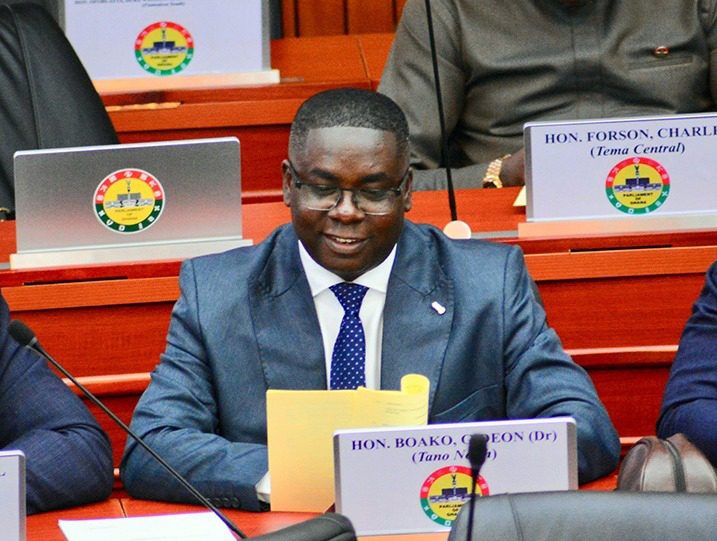
Member of Parliament for Tano North and Deputy Ranking Member on Parliament’s Finance Committee, Dr. Gideon Boako, has raised concerns over the Bank of Ghana’s revised Cash Reserve Ratio (CRR) policy, warning that the new measures could increase banking costs and tighten access to foreign exchange services for customers.
According to Dr. Gideon Boako, the Ghana Association of Banks’ request for what he described as a “crisis meeting” with the Governor of the Bank of Ghana shows that the policy is already putting pressure on banks’ liquidity management and foreign exchange operations.
Under the revised policy, all banks are required to maintain a uniform 20 percent Cash Reserve Ratio with the central bank.
This means a larger portion of customer deposits must remain locked at the Bank of Ghana and cannot be used for lending or investments.
He explained that for banks with high loan-to-deposit ratios, the move significantly increases operating costs because more funds are tied up without earning interest.
Even banks with lower lending exposure face challenges because they still pay interest on deposits while the reserve funds remain idle.
Another major concern is the extension of reserve requirements to foreign exchange deposits. Banks must now keep 20 percent of the cedi equivalent of FX deposits with the Bank of Ghana.
Dr. Gideon Boako said this could reduce available liquidity for trade finance and discourage banks from accepting more foreign currency deposits.
He warned that the likely outcome would be higher banking charges, tighter lending conditions, and stricter handling of FX accounts.
According to him, some banks are already signaling upward adjustments in service charges beginning in June.
Dr. Gideon Boako noted that the Ghana Association of Banks is expected to push for a phased implementation of the policy, exemptions for certain foreign exchange liabilities, or interest payments on mandatory reserves to reduce the financial burden on banks.
He believes a complete reversal of the policy is unlikely but expects the Bank of Ghana could consider partial concessions, including a gradual rollout or interest-on-reserve arrangements to ease the pressure on the banking sector.
The Tano North MP further cautioned that customers with dollar accounts may soon experience higher fees, longer processing times, stricter withdrawal limits, and wider exchange rate spreads as banks attempt to manage the additional costs created by the policy.
While the Bank of Ghana’s objective is to control liquidity, tame inflation, and support the cedi, Dr. Gideon Boako warned that a harsh implementation of the policy could create a credit and foreign exchange crunch that may slow economic growth.