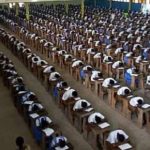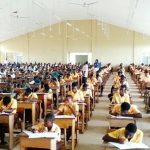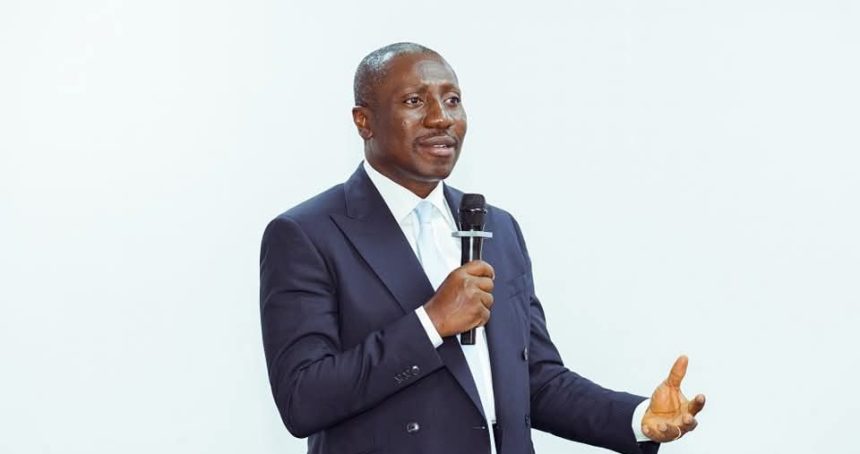
Minority Leader Alexander Afenyo-Markin has called for an urgent national conversation on Ghana’s education system, citing recent WASSCE and BECE outcomes as signs of challenges that could affect thousands of young people.
In a statement posted on his Facebook page, Mr Afenyo-Markin expressed concern about the latest West African Examinations Council (WAEC) results, particularly candidates’ performance in Core Mathematics and English Language.
He cited figures showing that 183,233 candidates completed secondary school without a credit in Core Mathematics, while the credit pass rate in English Language fell to 62.40%, the lowest level in four years.
He said performance in both subjects also remained below the levels recorded in 2024, describing the trend as a matter that should concern the entire country.
Mr Afenyo-Markin also raised concerns about the ongoing Basic Education Certificate Examination (BECE) school placement process.
He claimed that 54,985 candidates were initially denied automatic placement, while reports of students being placed in special schools despite not requiring such facilities, as well as students arriving at assigned schools only to discover that there was no space, required immediate attention.
He questioned the situation in light of government figures showing 859,828 vacancies for 623,072 candidates. According to him, vacancies reported on paper must translate into actual places for students.
“A self-placement portal is not a school place; every child needs an actual seat in a functioning classroom,” he said.
The Minority Leader warned that the figures he cited suggested that more than 200,000 young Ghanaians could be at risk of being left behind at different stages of secondary education.
He called on the government to publish the final placement outcomes and clarify the rules and pass marks used in the placement process.
Mr Afenyo-Markin also urged the government to adequately fund teaching and remedial programmes while providing alternative pathways into technical and vocational education and training (TVET), apprenticeships and skills development for students who do not obtain the required WASSCE credits.
He further called on the Mahama administration to treat the challenges as a national crisis requiring both immediate intervention and long-term solutions.
According to him, Ghana needs an “honest and non-partisan” discussion on educational funding, teaching quality, instructional contact hours, teacher motivation, learning materials, infrastructure and supervision.
“This must rise above partisan excuses because the future of an entire generation is at stake,” he stressed.
The Minority Leader also defended education policies introduced under the previous NPP administration, including the expansion of Free Senior High School (Free SHS), Free TVET, apprenticeship and skills-development opportunities.
He argued that the interventions were designed to ensure that poverty or examination results did not permanently deny young people opportunities for further education or skills development.
Mr Afenyo-Markin urged the government to act immediately, saying the 54,985 BECE candidates need actual school places, while the 183,233 WASSCE candidates who did not obtain a credit in Core Mathematics need opportunities to improve their prospects.
“Parents are worried, children are anxious, and teachers are under pressure,” he said.
He warned that failure to address the challenges confronting the education system could have long-term consequences for the country.
“When the education system is in crisis, Ghana’s future is also at risk,” he added.