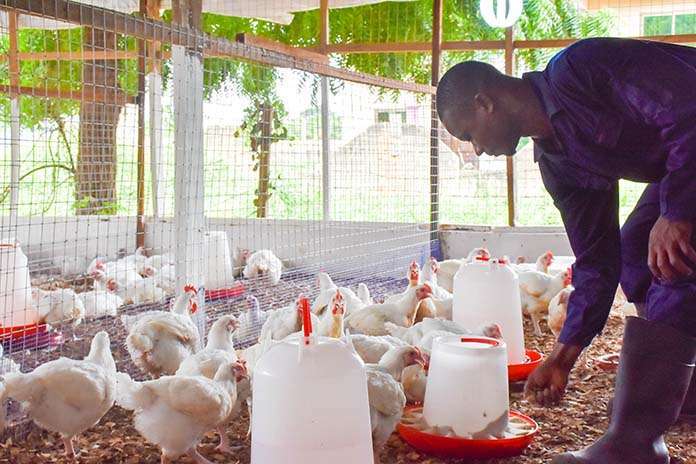
Stakeholders in Ghana’s poultry sector have raised alarm over the growing dominance of cheap imported chicken, warning that it is weakening local production and discouraging investment in the industry.
They argue that the continuous inflow of imported poultry products, which often sell at significantly lower prices, is making it difficult for Ghanaian farmers to compete on equal footing.
According to them, this situation is slowing down the expansion of domestic poultry farms and limiting job creation within the sector.
The concerns were highlighted ahead of the upcoming sixth Ghana Poultry Day, where industry actors are expected to deliberate on strategies to strengthen the poultry value chain and enhance its contribution to the national economy.
Executive Director and Founder of the Agrihouse Foundation, Alberta Nana Akyaa Akosa, stressed the need for sustained policy interventions to address what she described as long-standing market imbalances favouring imported poultry.
She explained that although demand for chicken remains high across the country, most consumers are driven by price and availability, giving imported products an advantage over locally produced chicken.
Ms Akosa noted that imported poultry benefits from large-scale production systems, subsidies, and well-established distribution networks, making them more attractive especially in urban markets.
She cautioned that without deliberate government action to level the playing field, Ghana’s poultry industry risks stagnation and may fail to reach its full economic potential.
To address the challenge, she called for stricter enforcement of market regulations, increased support for local producers, targeted subsidies, and public sensitisation campaigns to encourage the consumption of locally produced chicken.
She further argued that reducing reliance on imports would improve farmer incomes, create employment opportunities, enhance food security, and significantly reduce Ghana’s poultry import bill.
On his part, Deputy Minister for Food and Agriculture, John Setor Dumelo, acknowledged the concerns raised by stakeholders, noting that government is actively working to reduce poultry imports while boosting domestic production.
He explained that ongoing policy measures are aimed at increasing the supply of locally produced chicken to the market, which would gradually reduce dependence on imports and help stabilise prices.
The minister added that government support for commercial poultry farmers, alongside efforts to expand production capacity, is expected to improve both the availability and affordability of Ghanaian chicken in the long term.