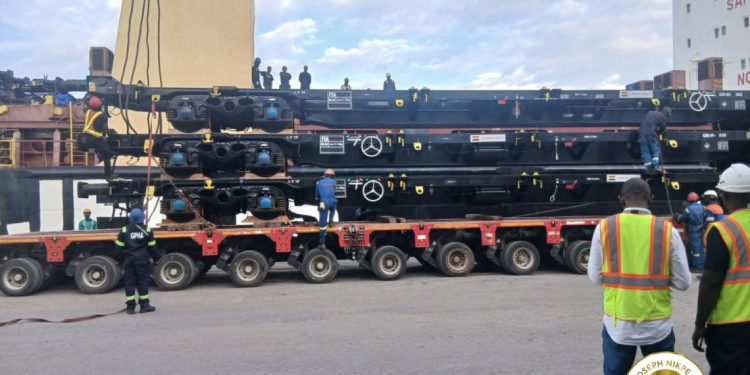
The Ghana Railway Development Authority has rejected claims by the New Patriotic Party (NPP) that the two locomotives recently acquired by the government are old and only suitable for a museum.
The NPP says information available to the Minority Caucus suggests that the locomotives are refurbished British Rail Class 56 diesel-electric engines.
According to the party, they were built in the United Kingdom between 1976 and 1983 and were previously operated by Colas Rail.
The Railway Development Authority, however, insists the locomotives were carefully selected after detailed technical assessments.
It said the decision was based on the type of locomotive needed, the railway line they will operate on, and the operational requirements of the Tema–Mpakadan railway.
Speaking to journalists on Monday, July 6, the Chief Executive Officer of the Ghana Railway Development Authority, Dr. Frederick Appoh, said the procurement was based on engineering and operational needs, not on how old the locomotives appear.
“I’ve heard rumours, of course. I’ve not really paid attention to them because, of course, it doesn’t matter. That the Class 56 is an old train. It is not. Class 56 has got three baselines. Baseline 1, 1974 to 1982. Baseline 2, 1984 to 1992. Baseline 3, 1992 to 1998. These are the baselines for the Class 56.
“Colas Rail, which operates in the United Kingdom. As of 2025, when I was in England, Colas Rail signed a five-year contract to operate the RATT contract with Network Rail. That’s 58 million pounds.
“DC Rail uses the Class 56 for movement of goods and other things. Thirdly, Class 56 fits perfectly in terms of attractive effort on the Tema-Mapakadan line. So, the question is, what was the technical justification for their statement? There’s none,” he said.
Dr. Appoh also highlighted the expected benefits of the GH¢38.7 million locomotive wagons, saying they will strengthen Ghana’s railway system and improve transport services.
According to him, the locomotives will help improve both passenger and freight services, make it easier to transport goods along the Tema–Mpakadan railway corridor, and reduce the heavy pressure on the country’s road network.