
The Minority Caucus in Parliament has intensified its opposition to the controversial 0.75% fee on MTN Mobile Money transactions, calling for the immediate and permanent withdrawal of any charges on wallet-to-bank and bank-to-wallet transfers that have not been approved by Parliament.
The demand comes after the Bank of Ghana (BoG) directed Mobile Money Fintech Limited (MMFL) to suspend the planned fee implementation and engage stakeholders for further consultations.
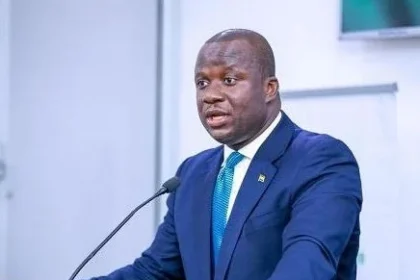
Speaking to the media in Parliament on Friday, May 29, 2026, Minority Leader Alexander Afenyo-Markin said the temporary suspension was not enough.
He argued that the policy should be scrapped entirely unless the government introduces a formal bill and secures parliamentary approval through legislation.
“The Bank of Ghana must permanently prohibit any wallet-to-bank or bank-to-wallet charge equivalent to a transaction levy unless authorised by an Act of Parliament,” the Minority Leader stated authoritatively.
The Minority is raising serious legal red flags over the mechanism used to introduce the 0.75 per cent charge. They argue that attempting to bypass the legislature by using private or state-backed fintech operators to collect transaction fees constitutes a direct violation of the 1992 Constitution of Ghana.
To address this structural overreach, Mr Afenyo-Markin has formally requested a swift legal intervention from the state’s chief legal advisor.
He tasked the Attorney-General and Minister for Justice to issue a definitive constitutional roadmap regarding how taxes and levies can be legally levied on the Ghanaian populace, explicitly citing parliamentary oversight protocols.
“The Attorney General must issue a formal opinion on the constitutionality of imposing levy-equivalent charges through fintech operators to bypass Parliament and Article 174,” Afenyo-Markin stated.
Minority Leader further has demanded that the Minister of Finance be hauled before the plenary to answer critical questions regarding the origin of the aborted fees and clarify the state’s relationship with the fintech operators.
“The Finance Minister must appear before Parliament to explain the decisions behind MMFL’s announcement and confirm whether the executive knew of or encouraged it,” he demanded.
The opposition caucus believes the proposed fee represents a betrayal of trust, especially given previous high-profile political commitments made by the ruling administration to protect the vulnerable digital economy.
Mr Afenyo-Markin concluded his press briefing by asserting that if investigations reveal the executive played a hidden role in prompting MMFL to introduce the fee, the government must formally render an unreserved apology to the Ghanaian electorate.
“Finally, the government must eat a humble pie by apologising to Ghanaians, the very people it promised for breaking a solemn electoral promise,” he added.