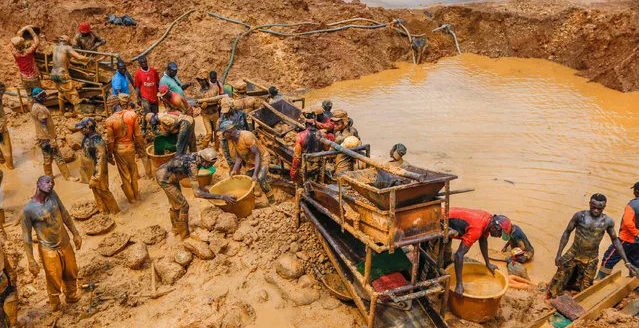
Convener of the OneGhana Movement and Trustee of the Ghana Coalition Against Galamsey, Senyo Hosi, says Ghana is nowhere close to winning the fight against illegal small-scale mining, popularly known as galamsey, despite years of interventions and enforcement efforts.
Speaking in an interview on Saturday, August 22, Mr Hosi said the success of the government’s anti-galamsey efforts should be measured by their impact on water bodies, forest reserves, food quality and national security.
He said available evidence, particularly on water quality, suggests that the country is rather moving backwards.
“I don’t think we should beat about the bush. The truth of the matter is that we are nowhere near winning the fight against galamsey. We are nowhere near winning at all, and it is fair that we say we have failed in that fight,” he said.
Mr Hosi said illegal mining has worsened significantly over the past two years, describing the increase as exponential rather than gradual.
He recalled that in August 2024, the estimated number of people involved in galamsey was between 14,000 and 14,500. By August 2025, however, the figure had reportedly risen to about 98,000.
According to him, the sharp increase should serve as a warning that existing interventions are not achieving the desired results.
Mr Hosi criticised the heavy focus on arrests, the destruction of mining equipment and other enforcement activities as measures of success.
He argued that the number of people arrested or equipment seized by the National Anti-Illegal Mining Operations Secretariat (NAIMOS) should not be the main benchmark for assessing the government’s anti-galamsey strategy.
“You can arrest one million people, and if the water is not improving, it is rather getting worse. Tell me, what is the policy outcome of the intervention?” he questioned.
Instead, he said the government should focus on measurable results, including reduced water turbidity and the restoration of degraded water bodies and forest reserves.
Mr Hosi also called on policymakers to publish relevant data to enable Ghanaians to independently assess whether anti-galamsey interventions are producing results.
He argued that policy discussions in Ghana often focus more on the resources and activities involved in an intervention than on its actual outcomes.
“This is the mistake we make in this country. We discuss policy from the point of input and not the output,” he said.
While acknowledging the government’s enforcement efforts, including the impounding and destruction of mining equipment, Mr Hosi insisted that such actions must ultimately lead to tangible improvements in the environment.
He further argued that Ghana missed a crucial opportunity during the first term of former President Nana Akufo-Addo to decisively tackle the galamsey menace.
According to him, the worsening situation highlights the need for a major rethink of Ghana’s approach to illegal mining.
Mr Hosi called for greater transparency, reliable data and rigorous evaluation of all anti-galamsey interventions, insisting that the government must demonstrate their real impact rather than simply highlighting arrests and equipment seizures.