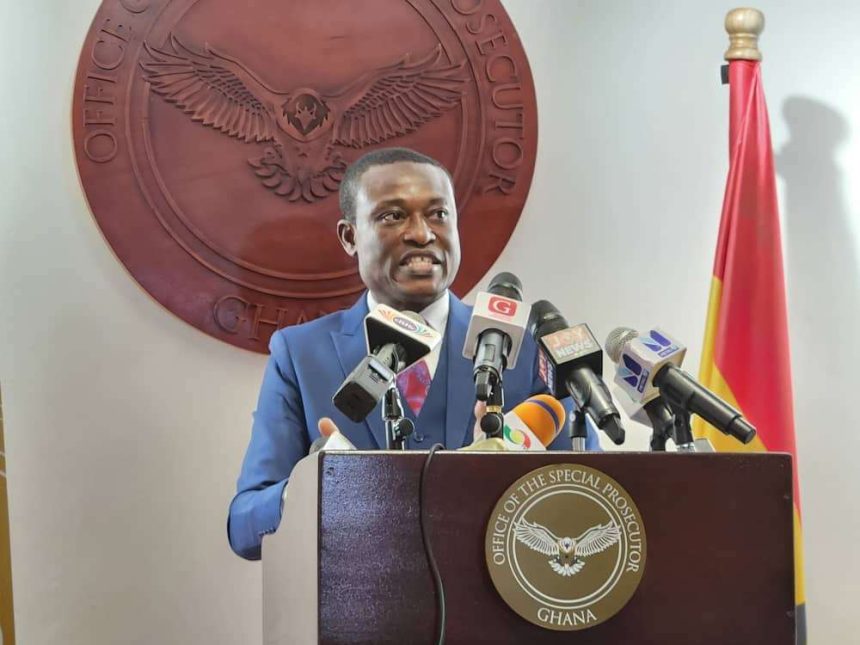
A coalition of 12 Civil Society Organisations (CSOs) has announced plans to apply to the Supreme Court to join an ongoing case as amicus curiae brief in support of the Office of the Special Prosecutor (OSP).
The case, which involves Noah Adamtey, focuses on the powers and constitutional standing of the OSP.
The coalition says its goal is to support the institution and defend its legality.
According to the group, this move is driven by growing concern among civil society actors about what they believe are attempts to weaken Ghana’s anti-corruption framework.
They argue that the OSP plays a critical role in ensuring accountability and must be protected.
Speaking to the media, representatives of the coalition stressed that taking away the OSP’s power to prosecute cases would significantly undermine the fight against corruption.
They noted that the office was deliberately established as an independent body with the authority to both investigate and prosecute corruption-related offences, particularly those involving politically exposed persons.
The coalition further warned that limiting these powers could weaken the institution and erode public confidence in Ghana’s efforts to combat corruption.
They also highlighted the broader implications of the case, noting that the Supreme Court’s decision could affect governance, transparency, and the rule of law.
In their view, any ruling that restricts the OSP’s mandate risks reversing years of progress in anti-corruption reforms.
Meanwhile, Kojo Asante, Director of Policy Advocacy and Engagement at CDD-Ghana, emphasised that efforts should focus on strengthening the OSP rather than reducing its authority.
“If we were even worried about legality issues, we have the constitutional review process to resolve them, so what is the hurry, what is the rush? So we are clear in our minds that there is nothing unconstitutional about it.
“What, of course, we had all agreed on was that when a constitutional review process came around, we would elevate the OSP to a constitutional body,” he said.
The coalition includes organisations such as CDD-Ghana, IMANI Africa, Transparency International Ghana, the Ghana Anti-Corruption Coalition (GACC), the Africa Centre for Energy Policy (ACEP), and NORSAAC, among others.
The coalition’s action comes amid ongoing legal disputes over whether the OSP has the authority to prosecute cases independently.
On April 15, 2026, an Accra High Court ruled that the OSP cannot prosecute criminal cases without prior approval from the Attorney-General.
The court also ordered that all ongoing OSP prosecutions be transferred to the Attorney-General’s Department and declared them invalid unless properly authorised.
The ruling followed a legal challenge by private citizen Peter Archibald Hyde, who questioned the constitutional basis of the OSP’s prosecutorial powers under Article 88 of the 1992 Constitution.
In response, the OSP rejected the decision as legally flawed, arguing that only the Supreme Court has the authority to interpret the Constitution or invalidate provisions of an Act of Parliament.
It has since taken steps to challenge the ruling.
The decision has sparked widespread debate, raising concerns about its potential impact on ongoing corruption cases and the stability of Ghana’s anti-corruption framework.
Several cases have since been filed at the Supreme Court to determine whether the OSP Act, 2017 (Act 959), grants the office independent prosecutorial powers.
Within this context, the coalition’s move to join the case is part of a broader effort by civil society groups, legal experts, and policymakers to defend the OSP’s independence while awaiting a final ruling from the Supreme Court.