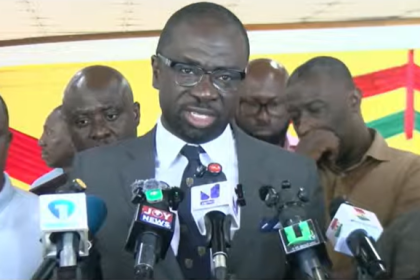
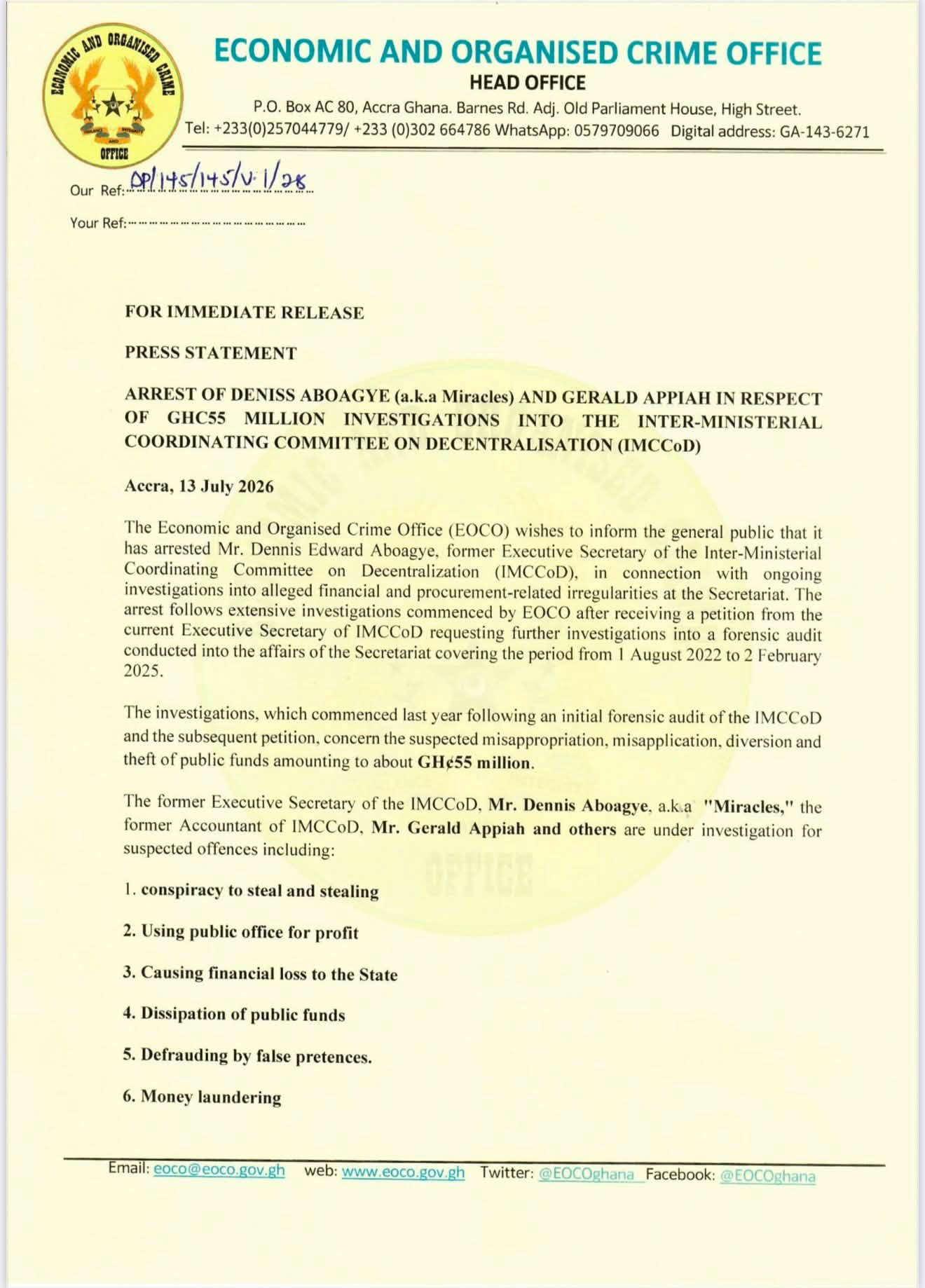
The arrest of former Executive Secretary of the Inter-Ministerial Coordinating Committee on Decentralisation (IMCCoD) and New Patriotic Party (NPP) communicator Dennis Miracles Aboagye over alleged financial and procurement irregularities involving GH¢55 million has once again placed Ghana’s anti-corruption architecture under intense public scrutiny.
Predictably, the government has framed the arrest as evidence of its commitment to fighting corruption, while the opposition has denounced it as political persecution.
Yet, beyond the partisan noise lies the question that should concern every Ghanaian: can our institutions enforce accountability without becoming instruments of politics?
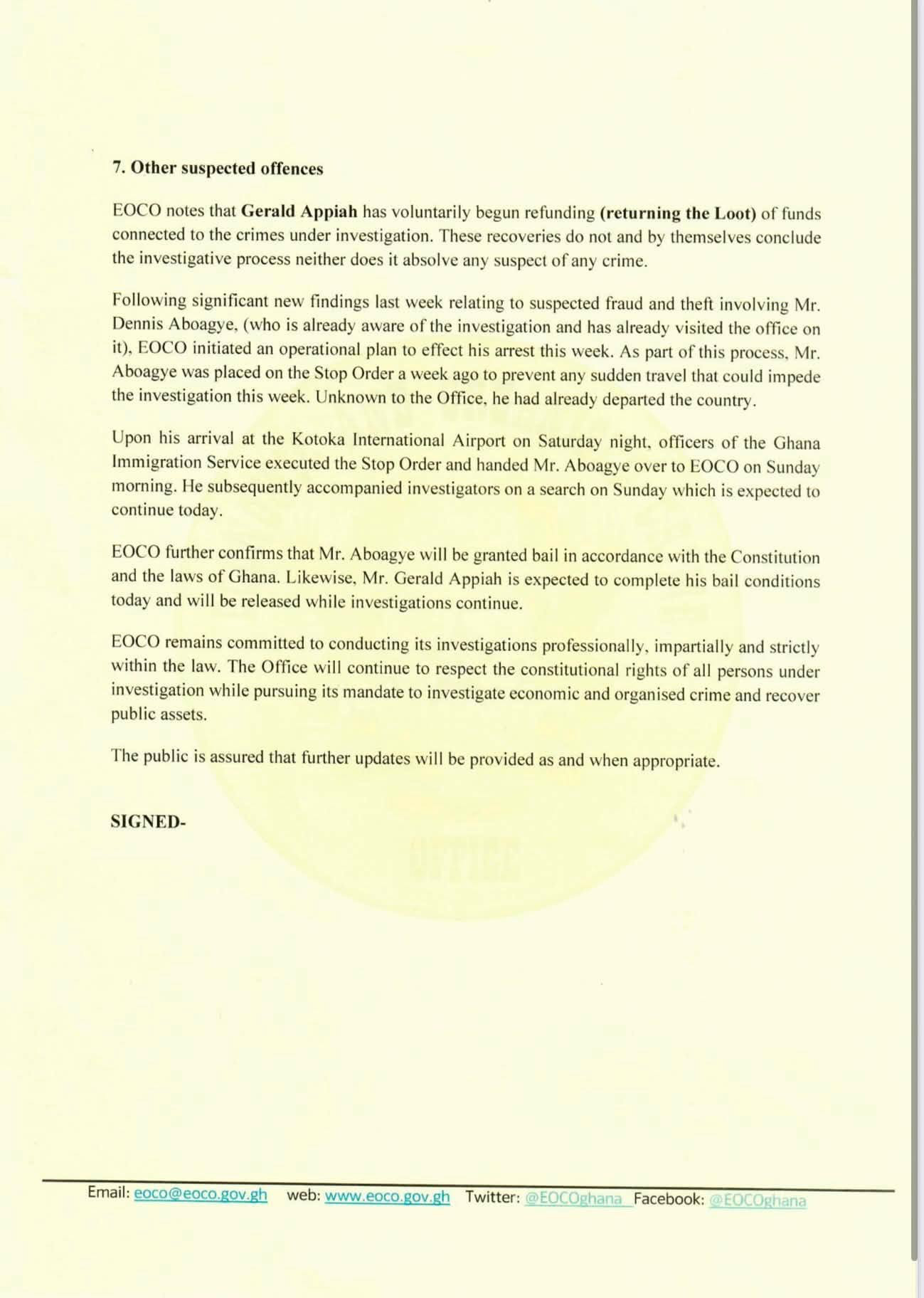
According to the Economic and Organised Crime Office (EOCO), the arrest follows a forensic audit and a petition alleging offences including conspiracy to steal, stealing, causing financial loss to the state, using public office for profit and money laundering.
These are grave allegations.
If supported by credible evidence, EOCO not only has the authority but the constitutional duty to investigate and prosecute.
Article 35(8) of the 1992 Constitution obliges the State to eliminate corruption and the abuse of power, while the Economic and Organised Crime Office Act, 2010 (Act 804) empowers EOCO to investigate and prevent serious financial and organised crime.
But the fight against corruption is judged not only by who is investigated but how investigations are conducted.
Article 14 of the Constitution guarantees every arrested person the right to be informed promptly of the reasons for the arrest, to legal representation and to be brought before a court within 48 hours if further detention is required.
These are not procedural inconveniences; they are constitutional safeguards against arbitrary state power.
Equally, Article 19 enshrines the presumption of innocence until proven guilty by a competent court.
International standards reinforce this principle.
The United Nations Convention against Corruption (UNCAC) requires investigations to be impartial and free from improper political influence. At the same time, the Organisation for Economic Co-operation and Development’s (OECD) Public Integrity Framework stresses that anti-corruption agencies earn public trust through operational independence, professionalism, transparency and the consistent application of the law, not through dramatic arrests or media spectacle.
The NPP must also resist the reflex of branding every investigation involving its officials as political victimisation before the facts are tested in court.
Conversely, the governing National Democratic Congress (NDC) must recognise that its anti-corruption credentials will be judged not by the number of opposition figures investigated but by whether the law is enforced consistently, including against its own officials when credible allegations arise.
Ghana’s challenge has never been a lack of laws.
It has been a credibility deficit.
Successive governments have accused each other of weaponising state institutions while defending their own when under investigation.
That cycle has weakened public confidence in the very institutions established to protect the public purse.
The Dennis Miracles Aboagye case must therefore become more than another political contest.
It must be a defining test of Ghana’s commitment to the rule of law.
If the evidence is compelling, let it withstand the scrutiny of an independent court.
If it is not, let the law vindicate the accused.
Justice must not only be done; it must be seen to be done, without fear, favour or political convenience.
Only then can Ghana convince its citizens that accountability is no respecter of party colours.