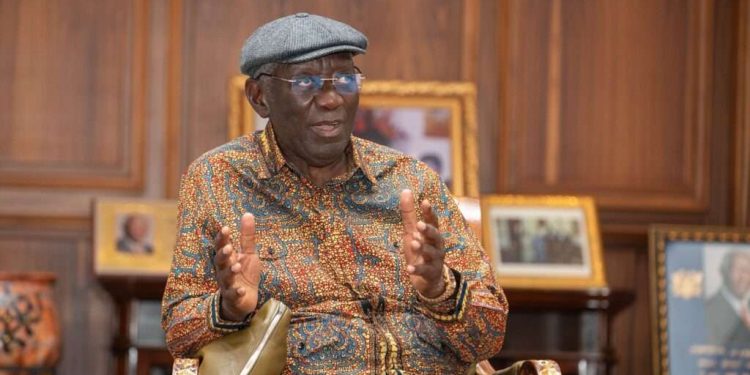
Former President John Agyekum Kufuor has said that Africa needs to move strongly into making chocolate and other finished cocoa products if it wants to earn more from the cocoa it produces.
Speaking at the Africa Cocoa Finance & Investment Forum (ACFIF 2026) held at the London Stock Exchange, he explained that Africa can no longer stay at the bottom of the cocoa business, where profits are lowest.
Even though Africa produces about 70% of the world’s cocoa beans, it does very little of the processing and makes less than 2% of finished chocolate. This means most of the money from cocoa is made outside the continent.
“The true economic value lies in chocolate manufacturing, branding, innovation, and long-term capital deployment,” he said, warning that the current structure leaves African producers with roughly 10% of the value chain.
Kufuor described the forum as an important chance for leaders, investors, and industry players to come together and fix these long-standing problems. The goal is to raise money and support development in Africa’s cocoa sector.
Using Ghana as an example, he talked about past efforts that helped increase cocoa production and processing. These included controlling crop diseases, improving how farmers are paid, and investing in local processing factories.
However, he said Africa now needs to work together as a continent to make bigger progress, especially through long-term investment and large-scale industrial growth.
He suggested four main ways Africa can build a stronger cocoa industry by 2040. These include improving farmers’ lives and involving young people, increasing value addition through processing and manufacturing, and focusing on funding, climate issues, and long-term investment.
“Africa must decisively expand into chocolate manufacturing, nutraceuticals, functional foods, and pharmaceutical applications. Cocoa’s health benefits, rich in antioxidants and flavonoids, remain grossly under-exploited, despite growing global demand.
“The third pathway is Capital, Climate, and Long-Term Investment, which is perhaps the most significant gap in Africa’s cocoa sector to achieve sustainability.
Addressing climate risk, industrial scaling, and job creation will not be possible without financing structures that reflect the biological realities of the times, including carbon-capture finance and the long timelines of manufacturing.
“Short-term financing cycles are fundamentally incompatible with cocoa’s production cycle and with the infrastructure investments required for processing and manufacturing,” John Agyekum Kufuor stated.
In the end, he encouraged investors and businesses to take the ideas discussed at the forum seriously and turn them into real projects. He believes cocoa can play a big role in helping Africa grow its industries and create jobs for its people.