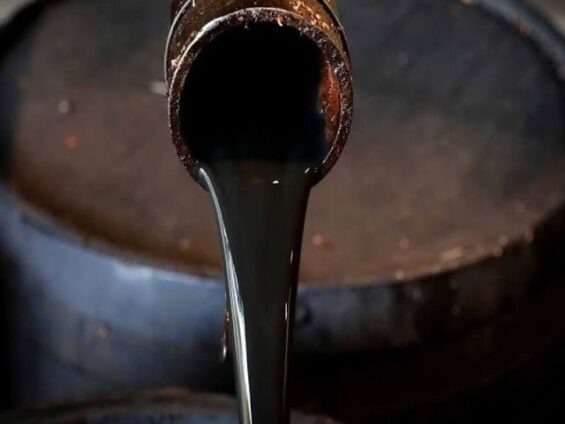
Ghana’s crude oil production has declined for six consecutive years, falling by nearly half since its 2019 peak and costing the country billions of dollars in lost revenue, according to a new report by the Institute for Energy Security (IES).
The analysis, authored by Smith Prosper Boahene and Prince Lumor, describes the prolonged downturn as a structural crisis driven by ageing oil fields, limited upstream investment and the absence of new petroleum agreements since 2018.
According to the report, crude oil output fell from 71.44 million barrels in 2019 to 37.30 million barrels in 2025, representing a decline of almost 48%. The Energy Commission projects production will fall further to 34.83 million barrels in 2026, extending the downward trend into a seventh consecutive year.
The report argues that the decline is “not a routine cyclical dip” but the result of deep-rooted operational and policy challenges.
“The decline is not attributable to one shock, but to several structural, operational, and policy failures compounding over an unusually long period,” the report stated.
The production slowdown has significantly affected government earnings from the petroleum sector.
IES said total petroleum receipts dropped by 43.27% from US$1.36 billion in 2024 to US$770.27 million in 2025. The decline was attributed to lower production volumes and a fall in the average realised crude oil price from US$86.12 to US$74.93 per barrel.
During the first half of 2025 alone, crude oil production declined by 26% year-on-year to 18.42 million barrels, while petroleum receipts fell from US$840 million to US$370 million.
The report also estimates that Ghana missed out on more than US$16.5 billion in potential gross oil revenue between 2019 and 2025.
Using what it describes as an “illustrative counterfactual”, IES modelled a scenario in which Ghana maintained a modest annual production growth rate of 3% through sustained drilling, new petroleum agreements and improved reservoir management.
Under that scenario, cumulative production would have exceeded actual output by about 221 million barrels.
The report identifies natural depletion of mature oil fields, insufficient replacement reserves and the failure to sign new petroleum agreements since 2018 as the principal causes of the production decline.