Representatives from across the tropical timber supply chain came together at Carrefour International du Bois in Nantes last week to discuss a key question facing the sector: how can the significant progress made by producer countries in strengthening legality, traceability and sustainable forest management be better recognised by markets and regulators?
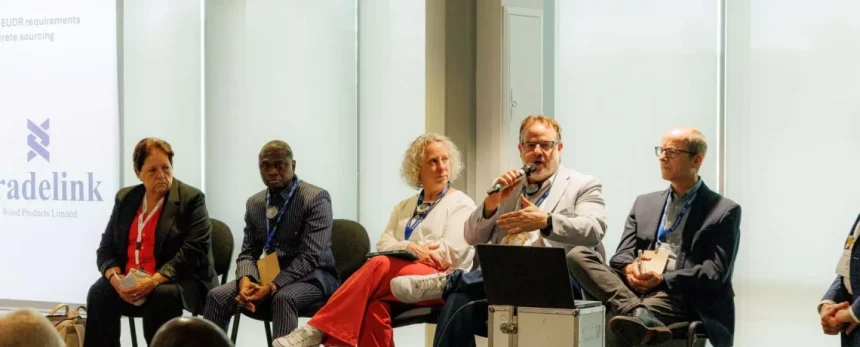
Hosted by Timber Development UK (TDUK) and ATIBT, the roundtable brought together speakers from the Ghana Forestry Commission, the Broader Market Recognition Coalition (BMRC), Interholco, Tradelink and ATIBT to explore how national forestry systems can align with evolving market expectations while continuing to support responsible trade.
Moderated by TDUK Chief Executive David Hopkins, the discussion focused on the growing importance of recognising and rewarding the efforts being made by governments, industry and forest managers to improve transparency, governance and sustainability throughout tropical timber supply chains.
Opening the session, David highlighted the importance of ensuring that progress made on the ground translates into confidence and recognition in the marketplace.
“What we want to be able to discuss today is how we can get the recognition in the market for the good efforts and the good work that is being done throughout the world by everyone involved in the forestry sector.”
A central theme throughout the discussion was the relationship between national forestry systems and emerging market requirements, particularly the EU Deforestation Regulation (EUDR).
While speakers acknowledged the opportunities presented by EUDR, there was broad agreement that implementation must recognise the substantial investments producer countries have already made in legality assurance, governance and traceability systems.
The audience heard from the Ghana Forestry Commission, which provided an update on Ghana’s implementation of FLEGT licensing and its national Legality Assurance System. Since issuing its first FLEGT licences in October 2025, Ghana has issued more than 650 licences covering approximately €80 million of timber exports and around 28,000m³ of timber products supplied to European markets.
Richard Gyimah of the Ghana Forestry Commission explained that legality assurance encompasses far more than simple legal compliance.
“If a timber is coming from Ghana and we say this timber is legal, what does it mean? It means that timber has respected seven principles, met about 23 criteria, and then it can pass as legal timber. You will see that it goes beyond legality.”
Richard also highlighted how Ghana’s legality framework incorporates environmental safeguards, worker protections, community engagement and social responsibility obligations, including agreements that ensure local communities benefit from forest operations.
The discussion reinforced the message that legality should not be viewed as a minimum standard. Emily Fripp, Team Leader of the Broader Market Recognition Coalition (BMRC), challenged common perceptions around legality and market recognition.
“Legality is a classic that I think has suffered from a sort of miscommunication. It seems to be a minimum in many markets and policies, and actually, legality is really difficult and really complicated.”
Participants also explored the role of transparency, independent verification and credible data in building buyer confidence. Transparency portals, independent monitoring, electronic timber tracking systems and certification were highlighted as important tools in demonstrating responsible forest management and supporting due diligence requirements.
From an importer perspective, Robbie Weich of Tradelink emphasised the importance of recognising the authority and expertise of source countries when assessing legality.
“In our opinion, as a manufacturer and importer, the only real party qualified to say if timber in the end is legal or not is the source country.”
The discussion also considered the opportunities that evolving market requirements may create for responsibly sourced tropical timber. Tom van Loon of Interholco argued that regulations such as EUDR could ultimately strengthen the position of tropical timber within international markets.
“I think in the long term this gives real market recognition to tropical timber. I think that’s very interesting for the market. It’s a positive development.”
Speakers agreed that achieving greater market recognition will require continued collaboration between governments, industry, trade associations, buyers and regulators. Initiatives such as BMRC’s work on national sustainable forestry systems and ATIBT’s emerging Code of Conduct were highlighted as examples of efforts to improve understanding and communication across the supply chain.
Françoise Van de Ven of ATIBT highlighted the importance of creating stronger links between organisations, markets and stakeholders working towards shared objectives.
“The problem is to link it and to link it well, so that the federations are a tool for information for customers and we are all talking for the same product: legal, traceable, sustainable and socially responsible timber.”
The discussion highlighted both the progress already made by producer countries and the opportunity to strengthen market confidence through greater transparency, communication and recognition of existing national systems. As regulatory requirements continue to evolve, ensuring that responsible producers receive appropriate market recognition will remain an important priority for governments, industry and buyers alike.
TDUK would like to thank ATIBT, the speakers and all participants for contributing to a highly engaging and constructive discussion.