.Imagine waking up one morning only to discover that you can no longer access your email account. Within minutes, you realise your social media accounts have also been taken over. Friends begin calling to ask why you’re asking them for money through WhatsApp. Before the day ends, your online banking profile has been locked because of suspicious login attempts.
It sounds like the plot of a movie, but for many people, this is exactly how cybercrime begins, not with sophisticated hacking, but with a compromised password.
In an age where our lives are increasingly connected to the internet, passwords have become the digital keys to our identities. They protect our bank accounts, emails, cloud storage, social media profiles, and even government services. Yet despite their importance, many people continue to underestimate the role passwords play in keeping them safe online.
The uncomfortable truth is that cybercriminals don’t always need to break into a system. Sometimes, they simply log in using a password that was easy to guess, stolen through deception, or reused across multiple accounts.
Why Passwords Still Matter
With technologies such as facial recognition and fingerprint authentication becoming common on smartphones, it’s easy to assume that passwords are becoming less important. They are not.
Biometric features often unlock your device, but behind the scenes, passwords remain the primary method of securing most online accounts. Whether you are accessing your email, online banking, work systems, or shopping platforms, your password is still one of the first barriers protecting your information.
If that barrier is weak, everything behind it becomes vulnerable.
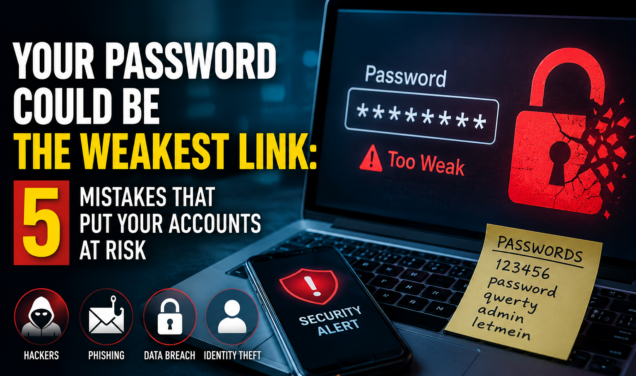
Five Password Mistakes That Put You at Risk
Using the Same Password Everywhere
One of the biggest mistakes people make is reusing the same password across multiple accounts.
Imagine using the same key for your house, office, car, and safe. If someone gets hold of that key, they gain access to everything. The same principle applies online. If one website suffers a data breach and your password is exposed, cybercriminals may try the same password on your email, social media, and banking accounts.
Choosing Predictable Passwords
Passwords such as 123456, password, qwerty, or even your date of birth may be easy to remember, but they are also among the first combinations attackers attempt.
Many people also use the names of their children, favourite football clubs, or phone numbers. While these choices feel personal, they are often easy to discover through social media or public information.
A stronger alternative is a long passphrase made up of unrelated words that is easy for you to remember but difficult for others to guess.
Ignoring Multi-Factor Authentication
Even strong passwords can be stolen through phishing attacks or data breaches.
This is why enabling multi-factor authentication (MFA) is one of the most effective security measures available today. MFA requires a second form of verification—such as a code sent to your phone or generated by an authenticator app—before access is granted.
Think of it as adding a second lock to your front door. Even if someone has your key, they still cannot get inside without the second layer of protection.
Sharing Your Password
Sharing passwords with friends, relatives, or colleagues may seem harmless, especially when done out of convenience. However, every additional person who knows your password increases the risk that it could be exposed intentionally or accidentally.
Passwords should remain private, regardless of how much you trust the other person.
Never Changing Compromised Passwords
If a company announces that it has experienced a data breach, many users assume it has nothing to do with them. In reality, if your account was affected, your password may already be circulating among cybercriminals.
Whenever you learn that one of your online accounts has been compromised, change your password immediately, especially if you have reused it elsewhere.
How Cybercriminals Steal Passwords
Contrary to popular belief, most attackers do not spend hours trying to guess passwords one character at a time.
Instead, they rely on techniques such as phishing emails, fake login pages, malicious software that records keystrokes, and databases of passwords leaked during previous breaches. They also use credential stuffing, an automated method of testing stolen usernames and passwords across multiple websites in the hope that people have reused the same credentials.
In many cases, the attacker succeeds because the victim unknowingly made the job easier.
Protecting Yourself Starts with Simple Habits
Improving your online security does not require advanced technical knowledge. A few simple habits can significantly reduce your risk.
Create a unique password for every important account. Use long passphrases instead of short words. Enable multi-factor authentication wherever it is available. Consider using a reputable password manager to generate and store complex passwords securely. Most importantly, think twice before clicking on unexpected links or entering your login details on unfamiliar websites.
Final Thoughts
Cybersecurity often seems like a complicated subject reserved for technology experts, but it begins with everyday decisions that every internet user can make.
Your password is more than just a way to log in. It is the first line of defence protecting your identity, your finances, and your personal information.
The next time you create a password, ask yourself one simple question: If someone tried to steal my digital life today, would this password stop them?
That answer could make all the difference.