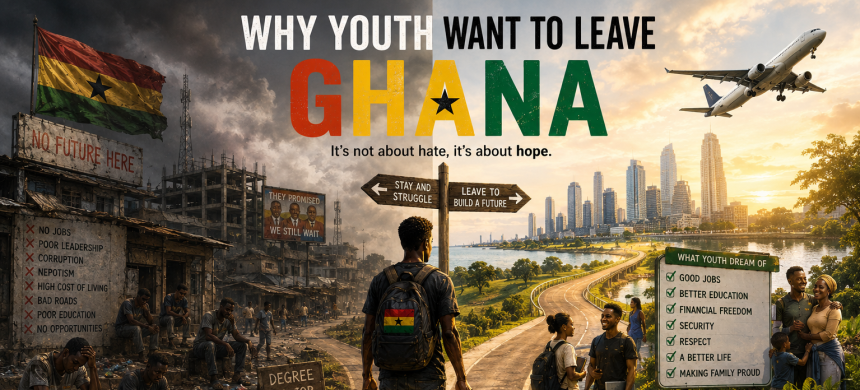
In recent years, one of the most common conversations among young people in Ghana is not about staying, but about leaving. It is heard in classrooms, offices, trotro conversations, and even family gatherings.
“If I get the chance, I will travel,” many say casually, but behind that sentence is a deeper reality that cannot be ignored.
The desire to leave is not always about rejecting the country. For many, it is about searching for something they feel is missing at home: stability, opportunity, and fairness.
It often begins after school. A young person spends years studying, writing exams, and dreaming about the future. Graduation comes with celebration, photos, and expectations. But after the excitement fades, reality sets in.
Jobs are scarce. Applications go unanswered. Opportunities are limited. Months turn into years of waiting, and hope slowly becomes uncertainty.
Even those who manage to find work often realise that income does not match the cost of living. Rent is high, transport keeps increasing, food prices fluctuate, and basic survival becomes a daily struggle.
Many young people are not even chasing luxury; they are simply trying to live comfortably without constant pressure.
Over time, frustration builds quietly. Not always in anger, but in tiredness. A feeling that effort does not always lead to progress. A belief that connections sometimes matter more than qualifications. Whether this is fully true or not, it shapes how many young people see their future.
Social media adds another layer. Every day, they see friends and strangers leaving the country, building careers abroad, or living what appears to be more stable lives. Even if those stories are incomplete, they influence perception. The idea of “making it outside” starts to feel more realistic than “making it here.”
There is also emotional exhaustion. Many young people feel they are constantly adapting to challenges instead of growing beyond them.
They are always adjusting to rising prices, unstable systems, and uncertain opportunities. That kind of constant adjustment wears people down over time.
At the same time, many still love their country deeply. Ghana is home — family, culture, identity, and belonging are all here. The desire to leave is not always rejection.
For many, it is a search for better systems, better opportunities, and a chance to build a more stable life.
This is why migration has become such a dominant conversation among the youth. It is not simply about travel or relocation. It is about hope, or the lack of it, within existing systems.
Until more young people feel that effort consistently leads to reward, and that opportunity is fairly accessible, the desire to leave will continue to grow.
Not because Ghana is unloved, but because many of its young people are still searching for a place where staying feels like progress, not struggle.
Why the youth want to leave Ghana.