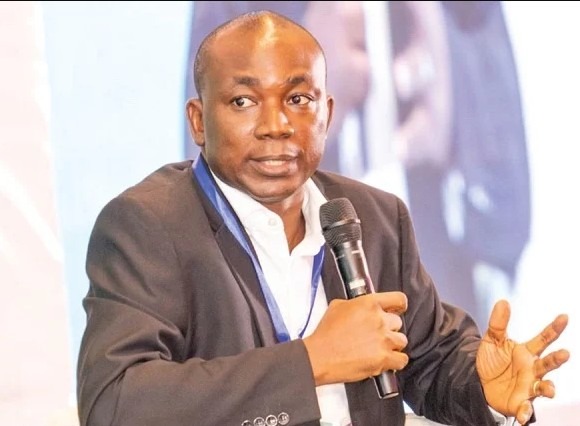
Professor of Finance and Economics at the University of Ghana, Godfred Bokpin, has raised concerns about the financial health of the Bank of Ghana (BoG), warning it could undermine confidence as Ghana prepares to exit its International Monetary Fund-supported programme.
Speaking in an interview on Monday, 5 May, Prof. Bokpin said the central bank’s financial statements present a worrying picture at a critical point in Ghana’s recovery.
“I felt a bit uncomfortable that the books of the Central Bank actually look like this at the time when we are planning to exit the IMF-supported programme,” he said.
He noted that this raises doubts about policy credibility and investor confidence.
“The books don’t look that credible to various stakeholders, investors, and stuff like that,” he added, warning that similar concerns have previously pushed Ghana to seek IMF support.
Prof. Bokpin said the losses themselves are not surprising, as they reflect an ongoing pattern.
“For me, it hasn’t been that surprising,” he said. “What we are discussing in 2026 is not so different from the narrative from the Central Bank in 2022 and 2023 when they booked losses.”
Although the losses are now larger, he pointed out that the Bank’s explanations have remained largely unchanged.
“The magnitude cannot be compared to what we are talking about in 2025, but the line of defence from the Central Bank is not entirely different from what we are hearing now,” he explained.
Despite his concerns, he said the situation offers an opportunity for greater transparency and public scrutiny.
“The only good thing now is that the cost of delivering low inflation or macroeconomic stability is now available to the people of Ghana to compare and to do some kind of cost-benefit analysis,” he said.
He emphasised that central banks are judged on how efficiently and prudently they implement policies, including the timing and mix of measures.
Prof. Bokpin urged a non-partisan national conversation on the issue.
“What we must discuss now… is that we’ll be able to take the politics out of it and really see the real culprit for this,” he stated.
He also criticised a long-standing practice where governments rely on the central bank to manage fiscal challenges.
“In the last couple of decades, politicians across the two main political divides have found a convenient way of sacrificing the balance sheet of the Bank of Ghana to clean up or to hold up for what they should have done,” he said.