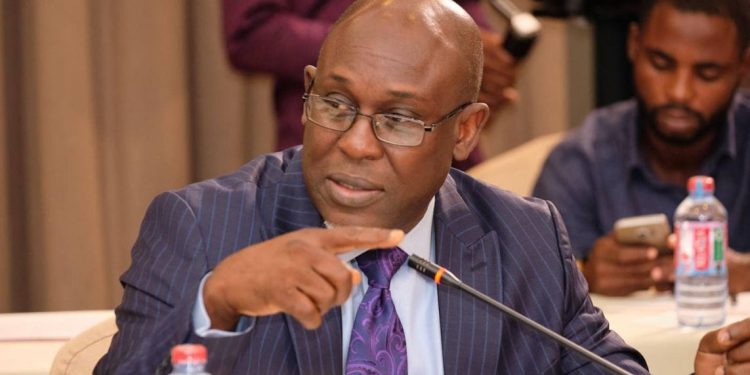
Lawyer and Senior Vice-President of IMANI Africa, Kofi Bentil, has said the Bank of Ghana should not be viewed as a profit or loss-making institution, but rather as one whose core mandate is to stabilise the economy.
He, however, raised concerns about the sustainability of recent financial losses being recorded by the central bank.
Speaking in an interview, Mr Bentil explained that the Bank’s operations are not meant to generate profit, but to ensure economic stability.
He stressed that with strong competence and sound policy choices, the institution should be able to achieve this without incurring large losses.
His comments come amid rising public and political concern over the Bank of Ghana’s projected GH¢15.7 billion loss for the 2025 financial year, which has sparked debate about the cost and long-term impact of recent monetary policy decisions.
He also pointed to what he described as unclear communication about the Bank’s financial position.
“There must be clarity. Are we making profits or losses? The communication is not clear,” he questioned.
Mr Bentil said that while losses can sometimes be justified if they contribute to long-term economic stability, they must ultimately lead to visible and meaningful results.
“If you take a loss to build something, then the value lies in what you build afterwards,” he stated.
He compared the Bank’s approach to “taking a bullet” for the wider economy, but questioned how long such an approach can realistically continue.
“How much of this can be sustained, and for how long?” he asked.
He acknowledged that difficult policy measures, including the Domestic Debt Programme (DDP), have helped ease economic pressures despite their short-term impact on citizens.
However, he warned that repeated losses without clear outcomes could amount to postponing economic challenges rather than resolving them.
Mr Bentil also raised concerns about policies in the gold sector, cautioning against situations where Ghana, despite being a gold-producing country, could end up effectively selling gold at a loss in efforts to combat smuggling.
He called for greater transparency and accountability from the Bank of Ghana, insisting that the public deserves clear explanations on the long-term sustainability and impact of its decisions.