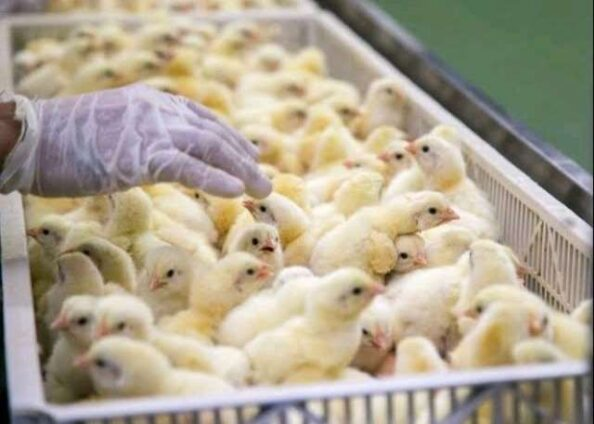
The Greater Accra Poultry Farmers Association has warned that government’s Nkoko Nkitinkiti initiative alone cannot revive Ghana’s poultry industry unless underlying challenges affecting production, particularly the high cost of animal feed, are addressed.
Chief Executive Officer of the Association, Ali Muhammed, said efforts to transform the sector must go beyond government interventions and focus on creating a coordinated system that supports farmers, input suppliers and processors.
Mr Muhammed said the lack of coordination between the agriculture and trade sectors has made it difficult for farmers to access affordable raw materials needed for poultry feed production.
He identified maize and soya as critical inputs in poultry production.
He argued that increasing local production of these commodities must be central to any strategy to reduce dependence on imported chicken.
“How do you increase your soya production? These are the major components in poultry production. There’s a total disconnect,” he said.
According to him, poultry farmers are not looking for short-term interventions or free support but sustainable policies that address the structural problems confronting the industry.
“Whenever we approach these policymakers, we are not in for the freebies. We want this thing to be sustainable. But there’s a lack of coordination,” he stated.
Mr Muhammed said although the introduction of the Nkoko Nkitinkiti programme initially raised hopes among farmers, the intervention has not sufficiently tackled the deeper challenges affecting commercial poultry production.
“When we saw intervention being led by government, we said hallelujah. Government is going to do something wonderful. But after some few months into the first phase of implementation, we said no, no, no. It’s only a catching phase,” he noted.
He stressed that the major challenge facing the sector is creating the right conditions for poultry farmers to operate profitably, citing the recent egg glut as an example of the difficulties producers face even after investing heavily in production.
“Why should the farmer, after going through all this hassle, raise birds, have these eggs, and there’s no market for egg products? It hurts a lot,” he said.
The poultry farmers’ leader also criticised gaps in the value chain, particularly the weak connection between maize and soya producers, feed processors and poultry farmers.
He explained that reducing feed costs would require a deliberate policy framework that links crop production to poultry production.
“The major input for poultry is actually the raw material for the feed. You talk about soya, you talk about maize. What is the coordination between the local farmers who plant the maize and the soya processors? There’s no coordination,” he said.
Mr Muhammed noted that high production costs continue to make locally produced chicken less competitive compared to imported frozen poultry products.
“The foreign frozen chicken is competitive because there’s one element called cost. The cost is manageable at their end. Without it, forget it,” he added.
He acknowledged that many Ghanaian consumers prefer locally produced chicken but explained that affordability remains the deciding factor for most buyers.
“The Ghanaian consumer knows the chicken that is best, and he can tell you the local chicken. But when the consumer gets to the market, it’s about disposable income against what he can afford. That’s the bottom line,” he said.