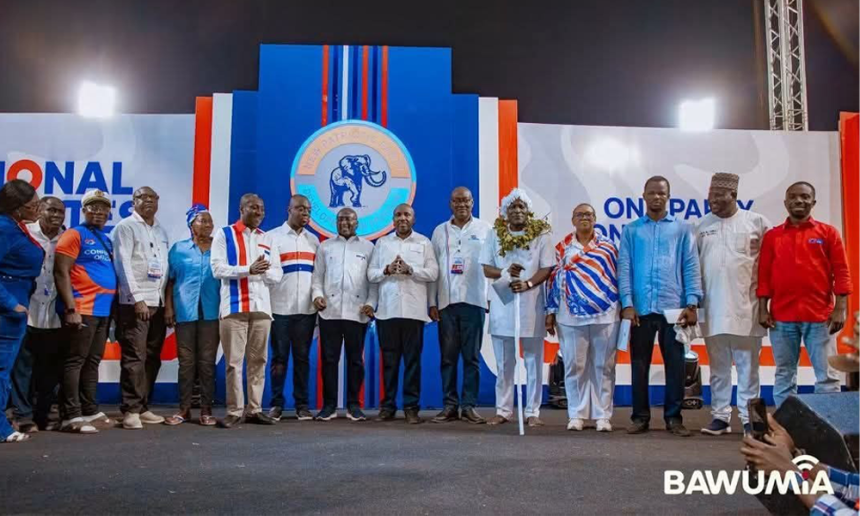
If the latest gathering of the New Patriotic Party (NPP) is anything to go by, the elephant may just be trying to reinvent itself, and, for once, without causing too much dust in the process.
I listened carefully to delegates as they moved around, chatted and strategised. Three names appeared to have occupied considerable space in their conversations: John Boadu, Hawa Koomson and Justin Kodua.
There were, of course, the usual colourful groups supporting the various candidates. They danced, sang and made enough noise to remind everyone that this was a political conference and not a Sunday afternoon picnic.
Yet, interestingly, there were no angry faces, no serious banter and, thankfully, no political equivalent of people throwing chairs at one another.
Perhaps the elephant is learning to trumpet without charging.
That spirit of relative calm was encouraging because, at the heart of the gathering, was an important exercise: an attempt to chart a new course for the NPP ahead of the 2028 elections.
There was, however, one elephant in the room that nobody could ignore: time.
The first part of the conference was scheduled to begin at 9 a.m. It eventually got underway after 1 p.m. Four hours late!
In Ghanaian political circles, this may qualify as “African time,” but even African time might have raised an eyebrow at that one.
For me, the delay was unacceptable. If a party wants to convince Ghanaians that it is ready to govern efficiently, it might want to start by governing its own clock.
When the votes were finally counted, John Boadu emerged victorious.
His victory could prove useful to the NPP. With his considerable experience, particularly in elections and party administration, he has the opportunity to help the party begin its preparations for 2028 much earlier and, hopefully, much more strategically.
Elections are no longer won by waking up when the whistle blows. The groundwork begins years before polling day.
Justin Kodua, meanwhile, has an opportunity of his own. Having served as General Secretary, he already understands the machinery of the party.
Working alongside someone with John Boadu’s experience could provide him with valuable lessons and further strengthen his political credentials.
But perhaps the result that caused the most raised eyebrows was the election of Kojo Boadu Bamba as First Vice Chairman.
That result was a reminder that political calculations are not always as predictable as the pundits make them sound. His victory speaks to his standing within the party and, perhaps more importantly, to the growing attention he is receiving beyond its traditional boundaries, including from well-known voices in the NDC.
When your political opponents start discussing you almost as enthusiastically as your own people do, you may want to pay attention.
But beyond the personalities and positions, there is a much bigger question confronting the NPP: Can the elephant reconnect with the voters who have moved on?
And here, one issue stands out, youth mobilisation.
Ghana’s electorate is young, energetic and increasingly demanding. Young voters are not necessarily impressed by political history alone. They want jobs, opportunity, accountability and a reason to believe that politics can improve their lives.
For the NPP, therefore, youth mobilisation cannot simply mean putting young people on platforms to dance during rallies or handing them party T-shirts and expecting gratitude.
It must mean listening to them, involving them, communicating with them in the spaces where they actually live and giving them genuine ownership of the political process.
The 2028 election will not be won merely by having the right slogans, the loudest brass band or the largest convoy.
The elephant will need a strategy, discipline, fresh energy and, perhaps most importantly, a willingness to listen.
So, is the elephant reinventing itself?
It is too early to say.
But if the latest conference is anything to go by, the elephant has at least started looking in the mirror.
Now, it only needs to decide whether it likes what it sees, and whether the Ghanaian voter does too.
The writer, Lansah Musah, is a news editor at Tolon Multimedia