
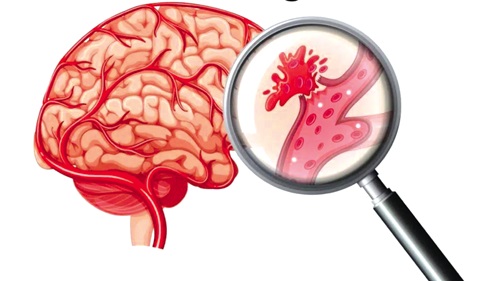
Haemorrhagic stroke is a condition that kills young people in Ghana every year. Ghanaian Culture Blog
Neurosurgery was not a relevant speciality for stroke when I was in medical school.
At the time, a stroke in Ghana (cerebrovascular attack) was usually from a clot blocking blood vessels supplying a part of the brain.
The typical stroke today in Ghana is more often from a blood vessel that ruptures.
This year, stroke became the top killer of human beings in this country.
Today, in the developed world, neurosurgery is crucial for care, whether the stroke is caused by a clot or ruptured vessels.
When a hemorrhagic stroke happens, the walls of affected blood vessels in the brain rupture, and blood rushes into the brain tissue.
This precious organ is housed in a bony skull which is incapable of expansion.
The blood clot occupies space in a brain that swells in reaction, because in the pristine corridors of electrical brain cell activity, blood is foreign.
The pressure in the skull keeps climbing, squeezing out and killing the brain cells after cell, until the hindbrain stampedes through the single large opening at the base of the skull.
This crowds out and strangles the uppermost part of the spinal cord, choking out the circuitry that maintains heart and lung function.
This is how a stroke kills.
Neurosurgeons
Before death, therefore, a tug of war is raging between two organ systems: One with blood under high pressure in expansile blood vessels, and the other with brain cells, almost a trillion of them in a rigid container of dura and bone.
Both systems are built to survive the worst challenges that life can throw at them.
Neurosurgeons know how this tango usually ends, and we have generally stayed away, until the last 50 years, when maverick surgeons started pushing again, because there was a new surgical armamentarium.
Accurate imaging enabled better diagnosis, the operating microscope revealed the hitherto hidden depths, and new instruments probed deeper and more accurately, with neuronavigation image guidance.
Now it is possible to plan a trajectory, find the bleed, isolate it and slowly prise the clot away from the swelling brain, arresting the vicious cycle of brain destruction, with minimal collateral damage.
Half of the people who suffer a hemorrhagic stroke will die, no matter what we do. Intervening surgically decides what kind of function the survivors will have.
Pushing the surgical frontiers has improved the outcomes of what would otherwise be a dire prognosis.
Mr K.
In Ghana, the situation is painful because the ecosystem of human resources, equipment, diagnostic capacity, and long-term follow-up is lacking badly. Ghanaian Culture Blog
The neurosurgeons who can do something about this are too few for a country of 36 million.
And what few there are, practice hamstrung, because what will make them capable of real impact is in countries other than their own.
We are stuck in a whirl of improvising and pushing ourselves to meet the need.
And there are times when the reward is overwhelming, but there are also times when practising feels like trudging forward in valley after valley of death and despair.
In Ghana, only seven per cent of our public hospitals have the kind of imaging needed for accurate diagnosis, only three public hospitals have operating microscopes, and only one public hospital has Neuronavigation guidance.
In Ghana, most neurosurgical care is in the public sector.
As the year starts, I am reminded of how grateful I should be to do what I do, even if I don’t have everything I need.
I look into 2026 with gratitude and a deep knowledge of the fact that I am blessed to do what I do, even if I don’t have everything I need.
I look back at 2025, grateful for all the work I have been able to do.
I look back, thankful for breaking ground in different ways with different dedicated teams.
This is a difficult path we have chosen, and I am thankful to walk it with some of the best human beings I have ever met.
There is one person who comes to mind when I think about hemorrhagic stroke, and my current surgical approach to it.