Death, as understood within the biblical framework, is a multifaceted phenomenon, deeply embedded in theological discourse, human experience and moral frameworks.
As a universal human condition, death is both biologically inevitable and theologically significant.
This analysis will elaborate on the biblical view of death by unpacking its scriptural roots, philosophical dimensions and the transformative message of resurrection.
First, it is vital to recognise that in the biblical narrative, death is a direct consequence of sin.
Theologically, death functions as a penalty for sin, a motif drawn from Genesis 2:17, where God warns Adam of death’s inevitability following disobedience.
This is further elaborated by Paul in Romans 5:12, where he asserts that “sin entered the world through one man,” thus making death an inevitable wage for sin.
This theological framing is not merely punitive; it serves to underscore the moral structure of the cosmos, where life and death are bound to human choices.
Differentiation
There is also the differentiation between physical and spiritual death, a distinction central to biblical anthropology.
Physical death is portrayed as a biological reality—an inevitable decay that all living beings undergo.
The Genesis narrative in Genesis 3:19 explicitly links physical death to humanity’s origin in dust—a return to the ground.
Spiritual death, in contrast, transcends bodily cessation; it is an existential severance from God.
Romans 6:23 describes spiritual death as a divine penalty, the ultimate estrangement from divine fellowship.
Thus, the biblical view sees death not only as a biological event but as a moral and spiritual rupture.
Old
In the Old Testament, death is often depicted as the final cessation of one’s existence, a view that reflects the Hebrew emphasis on mortality and the inevitability of death as a result of the fall.
Second Samuel 12:13-15 illustrates the Old Testament’s acceptance of death as the natural end of life, particularly in old age.
Yet, even in death, a theological tension arises: death is both a consequence of human sin (brought by Adam and Eve) and, in a broader sense, a cosmic intruder—something introduced by evil forces, as suggested by the article’s mention of Lucifer.
The New Testament, by contrast, reframes death as a defeated enemy. In Pauline theology, death is no longer a natural end but a conquered foe.
As the article emphasises, Paul calls death an “enemy” (1 Corinthians 15:54-57), a disruption that Christ, through His resurrection, has definitively subverted.
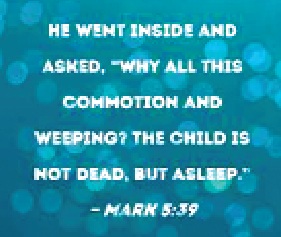
Jesus reinterprets death as a “sleep” (Mark 5:39), a temporary state from which resurrection awakens believers.
For Jesus, death is not the final word; God, the God of the living (Mark 12:26-27), overcame death’s dominion.
Thus, Jesus’ death and resurrection inaugurate a new reality, where believers no longer fear death but see it as a passage into eternal life.
Concept
Central to this New Testament vision is the concept of resurrection.
The Greek term “nekros” signals death not as the end but as a portal to resurrection.
Hebrews 2:14 emphasises that Christ, by partaking in death, destroys the devil’s power over it.
Thus, death, once wielded by Satan, is now subjected to God’s authority.
The biblical account does not deny the reality of death, but it reorients the meaning of death through the lens of Christ’s resurrection.
As Paul asserts in Romans 6:10, Christ dies once for all, thus overcoming death and alienation from God.
Consequently, for believers, death is reinterpreted; it is no longer a final defeat but a transition—a “sleep” from which resurrection awakens.
Hope
This hope in resurrection is the apex of New Testament teaching on death.
The early Christians did not merely anticipate a future life; they understood that resurrection was already at work in them.
As Colossians 1:18 states, Christ is the “firstborn from the dead,” meaning that His resurrection inaugurates a new creation.
Thus, the believer’s participation in Christ’s death is not just an abstract theological point; it is a transformative event.
When one responds to the gospel, death’s power diminishes because, as John 3:36 and 5:24 declare, faith in Christ passes one from death to life.
In this light, death’s impact is radically altered.
Through Christ’s death, believers no longer experience death as an alienating force but as a doorway to God.
This aligns with the broader biblical theme of hope—hope that despite death’s reality, God’s grace is greater.
Romans 8:20-21 reminds us that death is not only a human tragedy; it is an affliction that also touches the entire created order.
Yet, the good news is that those bound by death are not abandoned by grace.
Through faith, believers participate in Christ’s death and, consequently, His resurrection.
Thus, the biblical view of death is not a message of despair but of redemption; death, once the ultimate enemy, is now the conquered foe, and eternal life, made possible by Christ, is the ultimate destiny for those who believe