Every year, when the rains arrive, Ghanaians brace themselves for the inevitable. Local Ghana News
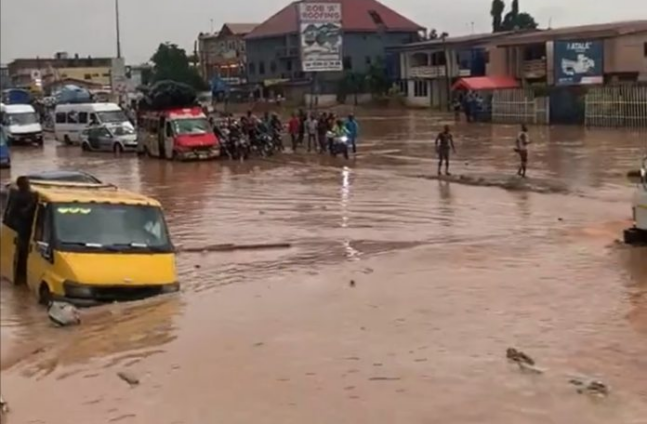
Roads become rivers.
Homes are submerged.
Families lose their belongings, and in some tragic cases, lives are lost.
Then comes the familiar cycle.
Government officials, city authorities, engineers, environmentalists and citizens engage in endless discussions about what the challenges are and who is to blame.
DSTV World Cup
Sifting through the arguments, the challenges can be categorised into three — engineering, human activities stemming from misbehaviour and climate change and population growth.
Some point to poor drainage systems.
Discover more
International News Briefs
Graphic Online Access
News
Others blame indiscriminate building on watercourses, plastic waste choking drains, weak enforcement of planning regulations, climate change or rapid urbanisation.
The debates dominate newspaper headlines, radio and television stations, and social media platforms.Today’s Ghana Headlines
Yet when the floodwaters recede, little to nothing changes.
The following year, the rains return and the inaction converts them to common disasters.
The question is no longer what causes flooding in Accra because that has been identified repeatedly for decades.
The real question now is: why have the solutions remained largely on paper?
There comes a point in the life of every nation when excuses become unacceptable, when recurring disasters can no longer be described as unfortunate events, and when leadership is measured not by promises made but by problems solved.
Ghana has reached that point in its decades-long struggle with flooding, particularly in Accra.Local Ghana News
For far too long, flooding in Accra has been treated as a seasonal occurrence rather than a national emergency.
It has become so common that many have accepted it as part of life in the capital city. Yet there is nothing normal about citizens losing their homes because of rain.
There is nothing normal about businesses shutting down because roads become impassable.
There is nothing normal about families looking on helplessly as years of hard work disappear under gushing floodwaters.
What is, perhaps, most frustrating and annoying is that the causes of the flooding are very well known to everybody.
Why would city planners and regulatory authorities look on for the drains to be blocked with waste, watercourses encroached upon and buildings are allowed to be erected in flood-prone areas.
Planning regulations are poorly enforced. Ironically, in applying the laws and by-laws lies the funds that will help the city and similar others to provide the drainage infrastructure that has become inadequate for a rapidly expanding city.
Some students walking through the floods
Some students walking through the floods
Wetlands that once absorbed excess water have disappeared under concrete and uncontrolled development.
Why should development be condoned at a Ramsar site? Having done so why not tax those culprits to provide them with the infrastructure needed to keep the place habitable?
Why should population growth be allowed to outpace urban planning?
Why should waste management systems remain insufficient in many communities why waste, actually, is a cash cow?.
The nation has known these facts for years.
Indeed, one only needs to examine the archives of Ghana’s newspapers to understand the scale of the failure.Local Ghana News
Since the 1960s, the Daily Graphic has consistently reported on flooding across Accra.
Overwhelming evidence
Year after year, journalists have documented submerged roads, stranded residents, destroyed properties, disrupted businesses, and promises of action from authorities.
Decade after decade, the headlines have remained remarkably similar.
The language changes.Newspaper Delivery Service
The dates change.
The names of officials change.
This means an entire generation had grown up reading stories about flood disasters.
Another generation is now reading the same stories.
Children who watched their parents battle floods are now adults battling the same floods in the same city.Today’s Ghana Headlines
The evidence of the crisis is overwhelming.
The devastating floods of June 3, 2015, affected more than 50,000 people and caused damage estimated at approximately $55 million, while reconstruction costs exceeded $105 million.
More than 150 lives were lost in that single disaster.
Studies further estimate that over 600 people lost their lives in flood-related disasters in Accra between 1968 and 2018.
These are not mere statistics.They are reminders of a national problem that has been allowed to persist for far too long.
Today, approximately $3.2 billion worth of economic assets in Greater Accra are exposed to flood risks.
According to the world bank’s analysis, Boosting flood resilience in Greater Accra, Ghana(2019). Local Ghana News
The figures could quadruple by 2050 if meaningful interventions are not implemented.
Asmita Tiwari, a Senior Urban and Disaster Risk Management Specialist at the world bank and task team leader for the Greater Accra Resilient and Intergrated development (GARID) project, has warned that continuos urban expansion without corresponding investments in flood resilience could dramatically increase the city’s exposure to flood related losses.
The world bank further estimates that more than 2.5 million residents within the Odaw River Basin remain vulnerable to flooding every rainy season.
These figures should alarm every policymaker because they reveal that the cost of inaction is growing faster than the solutions being implemented.
This is not merely a failure of infrastructure.
It is a failure of governance, planning, enforcement, coordination and long-term national commitment.
For more than 60 years, Ghana has documented, discussed, analysed, debated and investigated flooding in Accra.
The evidence fills newspaper archives, government reports, engineering assessments, academic studies, and public records.
The diagnosis has been made repeatedly.If the Daily Graphic archives from the 1960s, 1970s, 1980s, 1990s, 2000s, 2010s and now the 2020s can all produce headlines about flooding in Accra, then Ghana is not facing a flooding problem alone; Ghana is facing a failure to act on what it has known for more than 60 years.Newspaper Delivery Service
The patient does not need another diagnosis.
The patient needs treatment.
The people of Ghana have heard enough explanations.
They have listened to enough promises.
They have endured enough losses.
They have buried enough victims.Today’s Ghana Headlines
They have rebuilt enough homes and businesses.
What they seek is action now, not next year; not after another committee report; not after another disaster. Now!Accra cannot continue to drown while the nation continues to talk.
The time for conversation has long passed.
The time for solutions is now.Local Ghana News