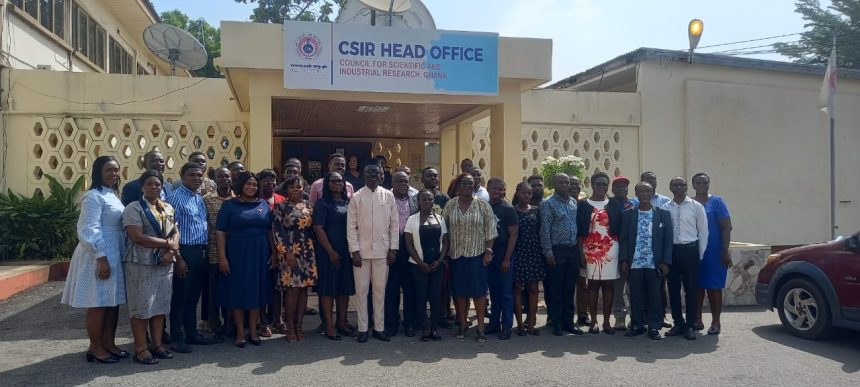
The Council for Scientific and Industrial Research (CSIR) has introduced a new plan to turn its research work into businesses that can generate income and jobs.
As part of this effort, the council is calling on industries and private companies to work closely with it.
The Director of the Science and Technology Policy Research Institute (CSIR-STEPRI), Dr. Wilhelmina Quaye, said Ghana must move away from doing research only for academic purposes and instead focus on research that supports economic growth.
She explained that CSIR has developed many useful innovations in areas such as agriculture, food processing, renewable energy, and digital technology.
However, many of these ideas have not been fully used because the country lacks strong systems to turn them into marketable products.
“Our focus is to ensure that research does not end on the shelf but is translated into products, services and enterprises that create jobs and wealth,” she said.
Dr.Quaye spoke at a policy dialogue and innovation fair held in Accra under the Sankore project.
This project is a partnership between CSIR Ghana and the UK Centre for Ecology & Hydrology (UKCEH), with support from UNESCO and the UK Foreign, Commonwealth Development Office.
The initiative aims to speed up research commercialisation, improve policies, and strengthen innovation systems in Ghana and Nigeria.
The event brought together policymakers, researchers, business leaders, and development partners. Thirteen institutes under CSIR also displayed their innovations.
Dr. Quaye highlighted several opportunities in agro-processing. These include producing value-added goods from crops like cassava, yams, cashews, and mushrooms.
She also mentioned improved technologies, such as flash dryers and better fish smoking systems, that help reduce post-harvest losses and meet export standards.
She added that CSIR has developed high-yield crop varieties and improved seedlings for oil palm and coconut. The council has also created digital platforms that give farmers advice and help them predict farming conditions.
Dr. Quaye said the council’s digital agriculture innovation hub aims to connect researchers directly with farmers and other users by making scientific knowledge easier to access.
“We have investment opportunities in technology transfer and licensing, scaling research innovations, public-private partnerships and agribusiness development,” she added.
However, she pointed out major challenges, including limited funding, weak collaboration with industry, and low adoption of research results.
She believes that with the right support, CSIR can play a major role in driving economic growth through innovation.
The Deputy Director-General of CSIR, Professor Marian Quain, also spoke at the event. She said research only becomes valuable when people can use it in real life, and businesses can grow from it.
“I urge our researchers to work hard, and our partners from industry to trust and invest in our innovations to build a sustainable, prosperous, and commercialised future for the country and beyond,” she said.