The Bank of Ghana has signalled that strengthening economic resilience, rather than relying on volatile foreign capital inflows, is becoming the central policy priority for emerging economies as geopolitical tensions, rising inflation risks and tighter global financial conditions reshape international markets.
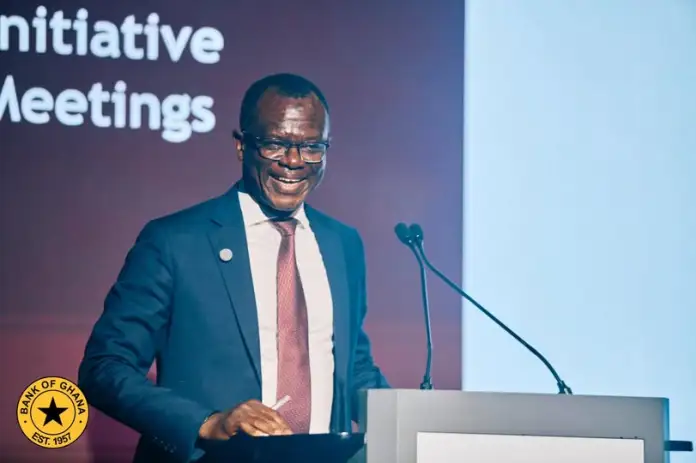
Speaking at the 64th ACI Financial Market Association (FMA) World Congress in Accra, First Deputy Governor Dr. Zakari Mumuni said the era of abundant and predictable global liquidity that supported emerging markets over the past decade has shifted materially, exposing countries with weak fiscal and institutional buffers to heightened financial instability.
“Global liquidity remains abundant, yet increasingly volatile,” Dr. Mumuni said in his keynote address. “Capital flows continue to provide important opportunities for emerging markets, but they also carry significant risks.”
His remarks come as policymakers globally reassess growth and inflation prospects following escalating tensions in the Middle East, which have disrupted trade routes, increased crude oil prices and heightened uncertainty across financial markets.
The International Monetary Fund has revised down its 2026 global growth forecast to 3.1 percent from 3.3 percent, warning that prolonged conflict could trigger further downgrades. The blockade of the Strait of Hormuz has already pushed up energy prices; reviving inflation concerns in both advanced and emerging economies and raising expectations of tighter monetary policy globally.
Dr. Mumuni said higher interest rates in advanced economies, particularly the United States, are likely to continue driving capital away from emerging markets toward safer assets, increasing refinancing risks and exchange-rate pressures for developing economies.
“For emerging and frontier economies, these developments carry important implications,” he said. “Global liquidity cycles directly affect exchange rates, reserve adequacy, debt sustainability, refinancing conditions and financial stability.”
The deputy governor argued that emerging economies must now focus less on attracting short-term inflows and more on building institutional credibility, reserve buffers and policy flexibility capable of withstanding external shocks.
He identified fiscal credibility, reserve adequacy, stronger financial sector regulation, institutional depth and attracting productive long-term capital as the five strategic priorities for emerging economies. “Reserve adequacy must be viewed as a form of self-insurance rather than a luxury,” he said, adding that countries must distinguish between productive long-term investment and volatile portfolio flows that can reverse abruptly during periods of stress.
His comments align with the Bank of Ghana’s recent policy posture as authorities attempt to preserve macroeconomic stability despite mounting external risks. Domestic economic indicators have improved sharply in recent months, although policymakers acknowledge rising vulnerability to external shocks.
The Composite Index of Economic Activity expanded by 12.6 percent year-on-year in March 2026, compared with 2.3 percent a year earlier, driven by stronger private-sector credit growth, industrial activity, consumption and trade.
Headline inflation edged up marginally to 3.4 percent in April from 3.2 percent in March, marking the first increase since December 2024, although core inflation continued to ease. Inflation expectations among consumers and businesses also rose slightly amid concerns over higher global energy prices and possible supply-chain disruptions linked to the Middle East conflict.
The Bank of Ghana has maintained a relatively tight monetary stance despite easing domestic inflationary pressures. Reserve money growth slowed significantly to 3.6 percent in April from 38 percent a year earlier, while broad money supply growth moderated to 22.2 percent.
At the same time, falling domestic interest rates have supported a rebound in private-sector credit. Average bank lending rates declined to 16.3 percent in April from 27.4 percent a year earlier, while real private-sector credit growth recovered to 24.5 percent from a contraction in the same period last year.
The banking sector’s balance sheet has also strengthened. Total industry assets increased 26.6 percent year-on-year to GH¢493.9 billion in April, while the capital adequacy ratio improved to 22.3 percent from 17.5 percent. The non-performing loan ratio declined to 18 percent from 23.6 percent, though the central bank said elevated credit risk remains a concern.
On the external front, Ghana’s current account surplus widened to US$3.10 billion in the first quarter from US$2.43 billion a year earlier, supported by strong gold and cocoa export earnings and stable remittance inflows. Gross international reserves rose to US$14.4 billion by May 18, equivalent to 5.7 months of import cover. However, the cedi has still depreciated by 8.4 percent against the U.S. dollar this year, reflecting energy-sector demand and corporate dividend outflows.
Dr. Mumuni said countries that successfully navigate future episodes of global tightening will likely be those that maintain disciplined fiscal and monetary policies while building stronger institutions over time. “The journey is challenging, and progress requires discipline, consistency and long-term commitment,” he said. “But the direction remains clear.”