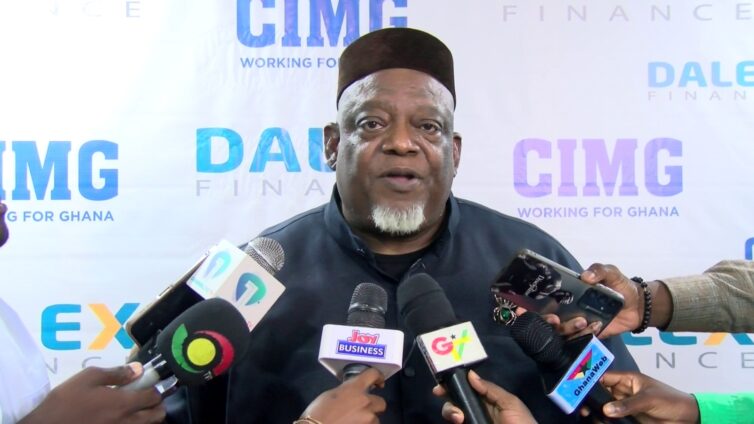
Economist and CEO of Dalex Finance, Joe Jackson, has warned that misunderstanding Ghana’s exchange rate challenges continues to put pressure on the cedi.
Speaking at the 2026 Dean of Business School Lecture Series at the University of Professional Studies Accra, he said the cedi’s story is one of volatility not just steady decline.
Between 2016 and 2024, the cedi lost nearly 71% of its value against the US dollar, but it rebounded sharply, gaining about 40% between 2024 and 2025.
According to him, this reflects deeper instability in Ghana’s economic structure.
He rejected the common view that the cedi is weak because Ghana does not export enough, noting that the country has recorded consistent trade surpluses in recent years.
The real issue, he explained, is what happens after export earnings come in.
Although Ghana earns substantial foreign exchange from gold, oil, and cocoa, much of it leaves the economy through service imports, profit repatriation, debt payments, and capital flight.
In 2024, for example, Ghana posted a $5.1 billion trade surplus, but nearly $8 billion flowed out through these channels.
In simple terms, Ghana earns dollars but loses them quickly.
He pointed to the gold sector as a clear example: while the country exported about $11.9 billion worth of gold, less than half of that value stayed in the local economy.
By contrast, countries like South Africa and Botswana retain more value despite producing less.
While he acknowledged the early impact of the Ghana Gold Board in improving gold trade and formalising small-scale mining, he said it does not address the biggest sources of foreign exchange loss.
He also warned that inflation remains a major threat.
After peaking at 54% in 2022, inflation stayed high through 2024, weakening the cedi by increasing import demand, raising interest rates, and reducing confidence in the local currency.
His noted that stabilising the cedi will require both retaining more value from exports and controlling inflation through disciplined fiscal and monetary policies.
Without this, the currency will remain vulnerable.
As he put it, a volatile cedi is not just an economic issue, it is ultimately a discipline problem.