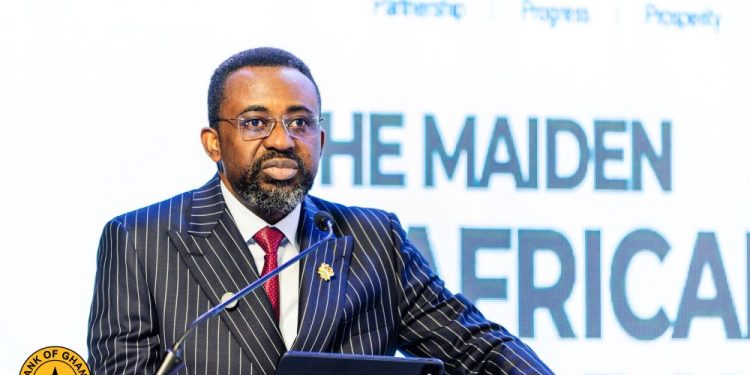
The Bank of Ghana (BoG) has launched a national Sustainable Finance Roadmap aimed at coordinating financial sector regulation, strengthening resilience to climate-related risks and positioning Ghana to attract growing pools of global capital for climate, infrastructure and sustainable development projects.
Governor Dr. Johnson Pandit Asiama said the framework marks a shift from fragmented sustainability initiatives toward a unified regulatory approach spanning banking, insurance, pensions and capital markets, as climate-related risks become increasingly material to financial stability.
“Sustainable finance is increasingly central to financial stability, long-term investment and economic resilience. It is reshaping where global capital flows and what investors expect of our financial systems,” Dr. Asiama said at the launch.
He said climate change is no longer solely an environmental concern but also a financial risk that directly affects asset values, insurance claims, lending decisions and stability of the financial system. Recent flooding, he noted, illustrates how climate shocks can quickly transmit into financial markets, requiring regulators to rethink supervision, risk pricing and long-term planning.
The roadmap establishes, for the first time, a common framework for Ghana’s financial regulators to coordinate sustainable finance policies. It is built around three pillars: integrating environmental, social and governance (ESG) principles into financial decision-making, strengthening climate-related financial risk management and expanding financing for sustainable development.
According to Dr. Asiama, the framework assigns clear implementation responsibilities to participating regulators – moving beyond broad policy commitments toward measurable actions intended to improve risk management while creating new investment opportunities.
The Governor said this roadmap also seeks to mobilise private and institutional capital through green and blended finance, support the country’s energy transition, deepen domestic financial markets and position Ghana as a regional sustainable finance hub.
“Our purpose as regulators has always been the financial system’s safety and soundness. But soundness in this era means more than absorbing today’s shocks. It means positioning Ghana’s financial sector as a leading destination for sustainable finance,” he said
The roadmap builds on nearly a decade of work by the central bank. In 2015, BoG established the Sustainable Banking Principles Steering Committee with the Ghana Association of Banks and Environmental Protection Agency. That effort culminated in the 2019 Sustainable Banking Principles, voluntarily adopted by all 23 commercial bank chief executives to integrate sustainability into governance, risk management and business operations.
BoG subsequently introduced a compliance assessment framework in 2021 with support from the International Finance Corporation (IFC) and Swiss State Secretariat for Economic Affairs (SECO). Industry compliance reached an average of 73 percent by September 2025. The central bank also issued a climate-related financial risk directive and a four-year sustainability strategy covering 2024-2028.
Minister of State in Charge of Climate and Sustainability, Seidu Issifu, said the roadmap signals Ghana’s intention to align its financial sector with national climate priorities while creating new investment opportunities.
He said embedding ESG principles into lending, insurance underwriting, investments and pension fund allocations will strengthen financial system resilience, mobilise domestic and international capital for climate-resilient projects and position Ghana to attract investment into emerging industries.
The framework also creates opportunities for banks to develop sustainability-linked lending products, insurers to expand climate and parametric insurance offerings, capital markets to deepen green and sustainability bond issuance and pension funds to finance renewable energy and resilient infrastructure, he added.
Frederick Amissah, Technical Advisor to the Minister of Finance, described sustainable finance as a financial stability, competitiveness and national development issue, arguing that climate-related events increasingly translate into fiscal costs through damaged infrastructure, food inflation and higher public investment requirements.
He said the roadmap complements the Ministry of Finance’s Green Finance Taxonomy and should serve as a practical implementation tool rather than a standalone policy document.
He also urged financial institutions to incorporate sustainability considerations more rigorously into credit decisions, particularly in sectors exposed to environmental risks.
The International Finance Corporation (IFC) also endorsed the Bank of Ghana’s newly launched Sustainable Finance Roadmap, describing it as a key policy framework that can strengthen the country’s financial system against climate-related risks while unlocking new investment opportunities – but cautioning that its success will depend on effective implementation.
Speaking at the roadmap’s launch in Accra, IFC Division Director for West Africa and the Gulf of Guinea, Ms. Nathalie Kouassi Akon, said the framework marks an important step in aligning Ghana’s financial sector with long-term economic development and emerging global sustainability standards.
“The full implementation of this roadmap will be the next frontier. It will require sustained capacity building, innovative financial products and an unwavering commitment to transparency and accountability,” she said.