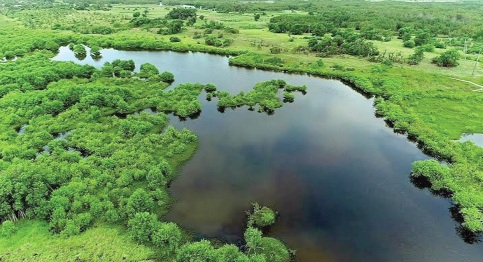
Protecting Ghana’s wetlands is not solely the responsibility of the Environmental Protection Authority, the Water Resources Commission, or the Metropolitan, Municipal and District Assemblies (MMDAs).
It is a national responsibility that requires strong leadership from the highest level of government.
Across Ghana, concerned citizens, resident associations, traditional authorities and civil society organisations frequently report illegal construction on wetlands and watercourses to the appropriate MMDAs.
Yet, in many instances, little or no enforcement action is taken.
Months, and sometimes years, pass without meaningful intervention.
By the time authorities eventually respond, permanent buildings have been completed, wetlands have been destroyed, and the environmental damage has become extremely costly, and in some cases impossible, to reverse.
Administrative accountability
This institutional inaction raises serious concerns about administrative accountability.
When an MMDA receives credible complaints of unlawful development and fails, without lawful justification, to investigate or enforce the law within a reasonable time, the consequences extend far beyond the particular development.
Such failures expose neighbouring communities to flooding, place lives and property at risk, damage public infrastructure and impose enormous financial burdens on the State.
Public office carries public responsibility.
Officials entrusted with enforcing planning and environmental laws have a legal and ethical duty to act promptly, impartially, and in the public interest.
Where investigations establish that officers deliberately ignored complaints, failed to carry out inspections, neglected to issue enforcement notices, or acted negligently or improperly, they should be held accountable through disciplinary proceedings and any other lawful sanctions provided under Ghana’s public service and local governance framework.
The President of the Republic, as Head of the Executive, has a constitutional responsibility to ensure that the laws of Ghana are faithfully executed.
The President should therefore require every MMDA to demonstrate measurable compliance with environmental and planning legislation.
Protection of wetlands should become a key performance indicator in assessing the performance of Metropolitan, Municipal, and District Chief Executives, Coordinating Directors, Physical Planning Departments, Works Departments, and Building Inspectorate Units.
Peugeot Ghana
International Best Practices
Many countries have successfully reduced flooding and protected environmentally sensitive lands by combining strong legislation with effective enforcement, institutional accountability, and modern technology.
Singapore has adopted a zero-tolerance approach to illegal development.
Every proposed development is carefully assessed before approval, while unauthorised construction attracts swift enforcement action.
Agencies responsible for planning, drainage, and environmental protection work together through integrated systems, ensuring that violations are detected and addressed at an early stage.
This proactive approach has contributed significantly to Singapore’s reputation as one of the world’s most resilient and well-planned cities.
The Netherlands, despite having much of its land below sea level, has become a global leader in flood management by preserving flood plains, protecting wetlands, and integrating land use planning with water management.
Rather than attempting to eliminate water, Dutch policy creates space for water to flow naturally, reducing long-term disaster risks.
Flood risk assessments
The United Kingdom requires flood risk assessments before developments are approved in environmentally sensitive locations.
Planning permission may be refused where developments are likely to increase flood risks or threaten surrounding communities.
This precautionary approach places public safety above short-term commercial interests.
South Africa recognises environmental protection as a constitutional right.
Strong environmental institutions have the authority to investigate violations, issue compliance notices, prosecute offenders, and require restoration of damaged ecosystems.
Courts consistently uphold the principle that economic development must occur within the framework of sustainable environmental management.
These international examples demonstrate a common principle: effective environmental protection depends not merely on good laws but on strong institutions, consistent enforcement, transparency and political commitment.
Environmental Compliance
Drawing on these international best practices, Ghana should establish a National Wetlands Compliance and Enforcement Framework to strengthen accountability across all MMDAs.
The framework should include a digital register of all wetlands and protected watercourses using Geographic Information Systems (GIS), satellite imagery, drones and digital cadastral mapping.
It should also include mandatory reporting and investigation of every complaint relating to illegal construction on wetlands.
The framework must clearly define timelines within which MMDAs must inspect reported developments and take enforcement action.
Again, it should have a central monitoring platform enabling the Ministry responsible for Local Government, the Environmental Protection Authority, the Water Resources Commission, and other regulatory agencies to monitor enforcement activities nationwide.
Annual performance reports
Provision should be made for MMDAs to publish annual performance reports on environmental compliance and development control as well as independent audits of enforcement decisions to promote transparency and eliminate selective enforcement.
In addition, the framework should provide comprehensive training programmes for planning officers, building inspectors, environmental officers, and enforcement personnel.
In terms of performance measurement, every MMDA should be assessed annually using measurable environmental performance indicators, including number of complaints received regarding illegal developments; time taken to investigate complaints; number of stop-work notices issued; enforcement notices served; and number of wetlands restored.
Assemblies that consistently demonstrate excellence should receive national recognition and additional institutional support.
Conversely, where persistent failures are identified, administrative reviews should be undertaken and appropriate corrective measures implemented in accordance with the law.
Leadership
Ghana cannot continue to respond to flooding as though it were solely a natural disaster.
In many cases, flooding is the predictable consequence of human decisions, weak enforcement, and institutional failures.
Every complaint regarding illegal construction on wetlands must be investigated promptly.
Every public official entrusted with protecting the environment must discharge that responsibility diligently.
Every MMDA must be held accountable for enforcing planning and environmental laws within its jurisdiction.
Protecting Ghana’s wetlands is not anti-development.
It is responsible development.
Sustainable economic growth depends upon preserving the natural systems that protect lives, infrastructure, businesses and communities.
Every wetland preserved reduces flood risks.
Every unlawful development prevented protects lives and public infrastructure.
Every public official who faithfully enforces the law strengthens the rule of law.