Ghana’s youth are its economic engine. Today, young people make up roughly 38% of Ghana’s population of about 35 million, meaning millions of young Ghanaians are entering, or preparing to enter, an economy that must create opportunities at an extraordinary pace.
The government estimates that Ghana needs to create about 300,000 new jobs every year just to keep pace with demand. But having a young population is only an advantage if young people have the skills, resources and opportunities to turn their potential into productive livelihoods.
For many young Ghanaians, that pathway remains difficult. Skills gaps, limited access to affordable capital, weak market linkages and other systemic barriers can prevent talented young people from converting ideas into viable businesses and sustainable jobs. The financing challenge alone can be daunting. Borrowing costs can reach 40% or more per year for some bank loans, while financing from some microfinance and community-based institutions can be considerably more expensive.
The result is an environment in which having an entrepreneurial idea is often not enough. A young person may have the ambition to start a business but lack the technical skills to produce a competitive product, the digital skills to reach customers, the financial knowledge to manage a business, or the market knowledge to understand what consumers actually want.
This is why youth skills development matters. Skills are not merely about getting young people into jobs. They are about giving young people the capacity to create jobs, solve problems, adapt to changing markets and build enterprises that can survive beyond their first few years. The challenge is even greater for young people living with disabilities, who often confront additional barriers to education, employment, finance and entrepreneurship.
Consider the story of Ayishetu Adam. Ayishetu is a 30-year-old woman born with albinism from Sagnarigu Kukuo in the Sagnarigu District of Ghana’s Northern Region. She has navigated lifelong stigma and discrimination in her pursuit of economic independence. Despite strong family support and attaining a Higher National Diploma in Communication and Media Studies, she faced persistent exclusion in the job market, with repeated rejections reinforcing both economic hardship and social marginalisation.
Her story is important because it demonstrates that talent and qualifications alone do not always guarantee economic opportunity. Sometimes, young people need a different pathway. One that gives them practical skills they can immediately translate into economic activity.
For Ayishetu, that opportunity came through a livelihood skills training programme implemented by Kosmos Innovation Center with support from AGRA in partnership with the Mastercard Foundation, under the Youth Entrepreneurship for the Future of Food and Agriculture (YEFFA) initiative.
Through the intervention, Ayishetu acquired hands-on skills in producing soybean-based products such as soy milk, kebab, cerelac, ice cream and porridge flour. She also received start-up materials to begin her own enterprise. Today, Ayishetu earns GHS300 (US$26.10) per day, with the potential to increase her earnings to GHS500 (US$43.50) per day.
Ayishetu already had an academic qualification. What she needed was an opportunity to acquire practical, market-oriented skills and the resources to put those skills to work. The intervention helped transform knowledge into a livelihood and a young woman who had experienced exclusion into an entrepreneur with greater economic independence. Her experience also makes a compelling case for inclusive skills development.
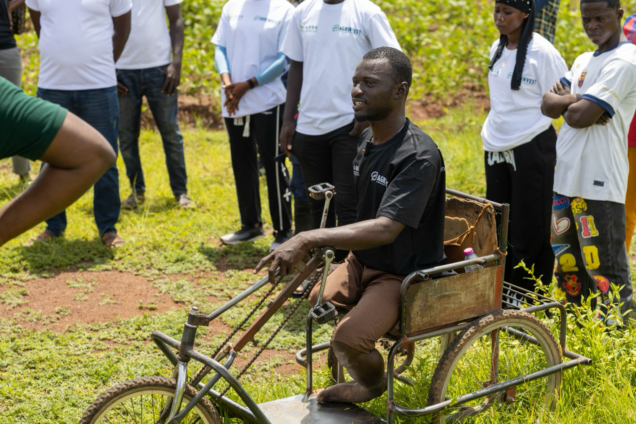
A second story is that of Salifu Suale, a 30-year-old person with disability from Gushegu in Northern Ghana. He is involved in soybean production but previously faced structural and physical barriers to accessing mechanisation services, particularly ploughing and threshing. His condition limited his ability to pursue tractor operators or compete for timely service, often resulting in prolonged delays.
With support from the Kumasi Institute for Tropical Agriculture (KITA), Agri Invest, and AGRA, Salifu was directly connected to private mechanisation service providers in his locality. Currently, Suale is able to utilise all three acres he owns, expecting to obtain about 4 metric tons of soybeans valued at about GHS 11,000 (USD 1,000). Suale intends to use income from agriculture to expand his existing shop, become a mobile money agent, and buy more stock for his retail shop.
The results were transformative, as Salifu avoided crop losses, improved the quality of the soybeans he produces, accessed markets at the right time, and obtained better prices. His productivity and income stability improved, and the intervention reduced the inefficiencies previously associated with his work.
These examples illustrate that if we are serious about harnessing Africa’s youth dividend, we cannot design opportunities only for young people who already have access to education, finance, networks, and employment. We must deliberately reach those who face additional barriers—including persons with disabilities, young women and young people living in underserved communities.
For development partners, governments, educational institutions and the private sector, the lesson is straightforward: invest in skills, but also invest in the systems that allow those skills to create value.