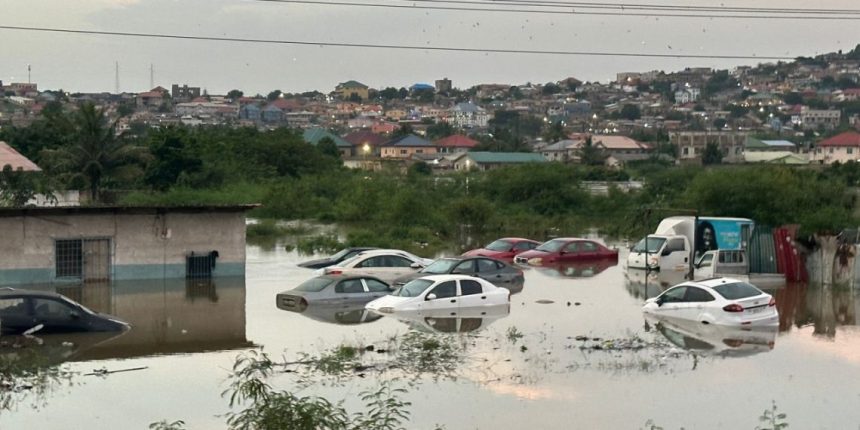
The nationwide clean-up exercise organised following the recent flooding and sanitation challenges was a welcome response.
Across the country, citizens, local authorities, Assembly Members and civil society organisations came together to clear drains and restore their communities.
Their efforts deserve commendation.
However, once the clean-up ends, Ghana must confront a more important question: what do these recurring floods and sanitation crises tell us about the state of our local governance system?
Much of the public discussion has focused on waste management, poor sanitation and climate change.
While these are undoubtedly contributing factors, they are only part of the story.
The recent floods also expose important questions about how effectively Ghana’s decentralisation system is functioning.
Article 240 of the 1992 Constitution envisions decentralisation as a means of bringing governance closer to the people, while the Local Governance Act, 2016 (Act 936) assigns Metropolitan, Municipal and District Assemblies (MMDAs) responsibility for local development, environmental management and the enforcement of local by-laws. These responsibilities are supported by Assembly Members, Unit Committees, Area and Zonal Councils, and the oversight functions of the Presiding Member.
When these institutions function effectively, communities should be able to identify risks early, enforce sanitation by-laws, maintain drainage systems, mobilise residents and respond proactively to local challenges before they become national emergencies.
Unfortunately, this is not always the reality.
Across many communities, Unit Committees and Area or Zonal Councils remain largely inactive or under-resourced despite being the closest governance structures to citizens.
Assembly Members often operate with limited logistical support, making it difficult to effectively monitor development projects, mobilise communities or ensure that Assembly decisions are implemented.
One institution that deserves greater national attention is the office of the Presiding Member.
While much public attention focuses on the Metropolitan, Municipal or District Chief Executive, the Presiding Member plays a critical oversight role within the Assembly.
Beyond chairing meetings, the office should ensure that Assembly committees function effectively, resolutions are implemented, and the Executive is held accountable for delivering on approved development priorities. Strong oversight is essential if Assemblies are to perform their constitutional mandate.
Assemblies composition
Another issue concerns the composition of the Assemblies themselves.
The Local Governance Act provides for 30 per cent of Assembly members to be appointed to broaden the knowledge, experience and representation available to local government.
The intention is that these appointments strengthen Assemblies with professionals, community leaders and individuals with technical expertise in areas such as planning, education, engineering, environmental management, public health and local development.
Where appointments are driven primarily by political considerations rather than the need for technical expertise, Assemblies risk losing the independent knowledge required to scrutinise budgets, strengthen Medium-Term Development Plans and improve service delivery.
The result is weaker planning, weaker oversight and poorer implementation.
These institutional weaknesses also have financial consequences.
Weak enforcement of by-laws and ineffective local administration undermine Internally Generated Funds (IGF), increasing dependence on central government transfers and reducing the ability of Assemblies to invest in preventive measures such as drainage maintenance, waste management and environmental protection.
Challenges
Importantly, these governance challenges are not gender-neutral.
Women often bear the greatest burden when floods occur, from loss of livelihoods in markets to increased unpaid care responsibilities and heightened health risks for their families.
Children are also disproportionately affected through disrupted schooling, unsafe environments and increased exposure to disease.
Strengthening local governance is therefore not only about improving public administration; it is also about advancing gender equality, protecting children and building resilient communities.
The recent clean-up exercise should therefore be seen as more than an environmental campaign.
It should be a catalyst for strengthening Ghana’s decentralisation system.Ghana Journalists Association
Revitalising Unit Committees and Area and Zonal Councils, empowering Assembly Members, reinforcing the oversight role of Presiding Members, ensuring that the 30 per cent appointed membership reflects the technical expertise envisioned by law, and improving enforcement of local by-laws are all essential steps towards more responsive local governance.
Natural hazards will continue to test our communities.
Whether they become governance crises depends largely on the strength of the institutions closest to the people.
If Ghana is committed to building resilient, inclusive and sustainable communities, then strengthening local governance must become part of the national conversation.
The true measure of decentralisation is not how effectively we organise clean-up exercises after floods, but how effectively our local institutions prevent those floods from becoming avoidable disasters in the first place.