Public Interest and Accountability Committee (PIAC) has accused Ghana’s Finance Ministry and Parliament of breaking the law by keeping the cap on the Ghana Stabilisation Fund at $100 million between 2021 and 2025, instead of the required $584.22 million.
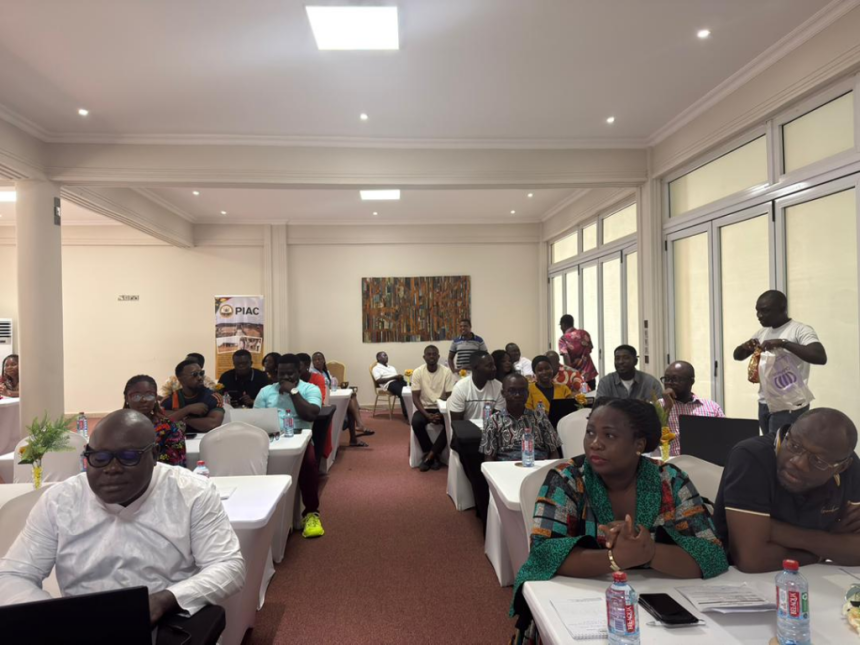
Speaking at a media briefing on PIAC’s 2025 Annual Report over the weekend, Samuel Bekoe, Chair of PIAC’s Technical Sub Committee, explained that the Petroleum Revenue Management Act clearly states that the cap on the fund should be based on the average expected oil revenue over three years.
According to him, Ghana is expected to earn about $1.75 billion in oil revenue from 2024 to 2026. This means the legal cap for 2025 should have been around $584.22 million, not $100 million.
Mr Bekoe said both the Finance Ministry and Parliament failed to follow the law by approving a much lower amount.
He called on the Finance Minister to apply the correct figure in future budgets and urged Parliament to ensure the law is properly followed during budget approvals.
PIAC also asked the government to pass a law that will guide how money meant for the “Big Push” programme is transferred from the Annual Budget Funding Amount (ABFA) to the Ghana Infrastructure Investment Fund (GIIF).
Mr Bekoe pointed to GIIF’s investment in the Accra International Airport as an example of how effective the fund can be.
He said GIIF invested $30 million in the airport project between 2017 and 2025 and earned $17.9 million in interest and fees, nearly 60 percent of the original investment.
PIAC is therefore recommending that GIIF be brought back under the Petroleum Revenue Management Act so it can receive funding from the ABFA for profitable national projects.
On changes to the Petroleum Revenue Management Act, Mr Bekoe noted that the law has been amended several times since it was introduced in 2011.
He said a major review process started in 2018 and 2019, but stalled between 2020 and 2024.
He also revealed that Parliament passed two amendments to the law in 2025 alone.
The first amendment, passed in March, limited the use of the ABFA strictly to infrastructure projects under the Big Push programme.
It also removed PIAC’s guaranteed funding from the ABFA and reduced the allocation to the Ghana National Petroleum Corporation from 30 percent to 15 percent.
According to Mr Bekoe, a second amendment passed in December expanded the investment options available to the Ghana Petroleum Funds.
He said the Finance Minister explained that the new amendment would allow money from the Ghana Heritage Fund to be used for energy sector projects and the government’s proposed 24-Hour Economy Programme.
Mr Bekoe, however, warned that this could create legal and policy challenges in the future. He explained that 2026 will mark 15 years since the Petroleum Revenue Management Act was passed, the first time Parliament can review the rules on withdrawals from the Ghana Heritage Fund.
Under the current law, only part of the interest earned on the fund can be withdrawn, while the main savings remain untouched.
However, Mr Bekoe said the law does not clearly state how much can be withdrawn, which creates uncertainty.
PIAC is therefore calling for a full review of the Petroleum Revenue Management Act instead of making small changes bit by bit.
Mr Bekoe said the revised law should clearly explain how projects are selected, improve monitoring of spending, and allow independent checks on project performance.
He also urged the government to publish complete details of projects funded with oil money, obey the law requiring five percent of oil revenue to go to the District Assemblies Common Fund, restart the stalled 2019 review process, and develop a long-term national development plan approved by Parliament.