The National House of Chiefs has urged the government to urgently implement a long-term and practical solution to Ghana’s recurring flooding challenges, following recent floods that left at least 12 people dead and displaced thousands across the country.
The appeal comes in the wake of a severe 48-hour rainfall that caused widespread destruction in parts of Accra, Tema, and other regions.
The floods affected homes, businesses, and transport systems, while several communities were left stranded as emergency services worked to respond.
Among the victims were women and children, with rescue teams continuing recovery operations in affected areas.
The disaster also prompted a large-scale response from the National Disaster Management Organisation (NADMO), supported by the Ghana Armed Forces, the Ghana Police Service, and the Ghana National Fire Service.
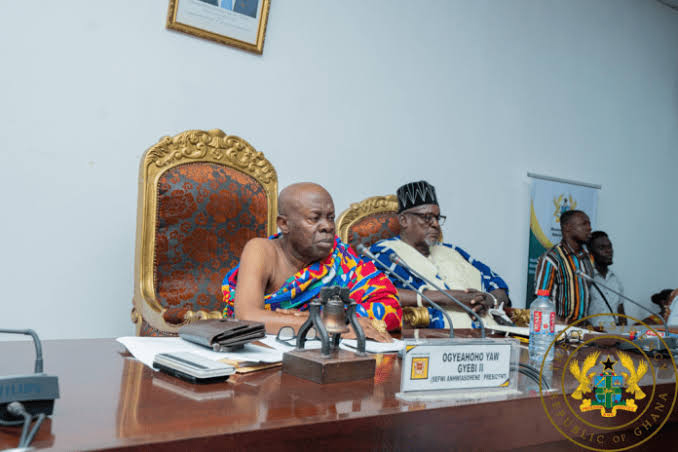
At a meeting of the National House of Chiefs in Kumasi, its President, Ogyeahoho Yaw Gyebi II, expressed sorrow over the loss of lives and extended condolences to bereaved families.
He also wished a speedy recovery to those who sustained injuries during the disaster.
Ogyeahoho Yaw Gyebi II stressed that the repeated occurrence of flooding across the country highlights the need for urgent preventive action rather than temporary responses.
He called on the government and relevant stakeholders to adopt stronger, long-term measures to address the root causes of flooding.
According to him, Ghana can no longer afford to treat flooding as an isolated or seasonal incident, given the scale of damage and loss of life recorded in recent years.
He urged authorities to prioritise improved urban planning, drainage infrastructure, and disaster preparedness systems to reduce the impact of future rainfall events.
The National House of Chiefs further expressed its readiness to support national efforts aimed at finding sustainable solutions to the problem, while reaffirming its solidarity with all communities affected by the recent floods.
The latest flooding adds to a growing concern over urban drainage systems in major cities, where rapid development and blocked waterways have continued to worsen the impact of heavy rains.