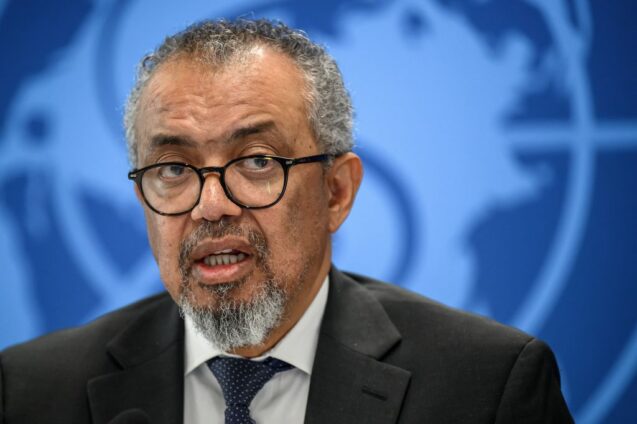
The Director-General of the World Health Organization, Tedros Adhanom Ghebreyesus, has expressed concern over the worsening Ebola outbreak in the Democratic Republic of Congo and Uganda, warning that the disease poses a serious threat to the region as suspected cases and deaths continue to rise.
Speaking at a media briefing on Wednesday, May 20, Dr. Tedros said that in addition to the 51 confirmed Ebola cases in DR Congo, health officials are monitoring nearly 600 suspected infections and 139 suspected deaths.
“We expect those numbers to keep increasing, given the amount of time the virus was circulating before the outbreak was detected,” he warned.
The WHO chief announced that he had declared the outbreak a Public Health Emergency of International Concern (PHEIC) on Sunday, stressing the need for urgent international support to control the spread of the virus.
According to him, this is the first time a WHO Director-General has declared a PHEIC before convening an Emergency Committee under the International Health Regulations.
The World Health Organization said the outbreak currently presents a high risk at both the national and regional levels, although the global risk remains low.
Confirmed cases in DR Congo have been reported in the northern provinces of Ituri and North Kivu, including the cities of Bunia and Goma.
Uganda has also confirmed two cases in the capital, Kampala, including one death involving people who travelled from DR Congo.
An American citizen working in DR Congo has also tested positive and has been transferred to Germany for treatment.
Dr. Tedros said several factors are increasing concern over the outbreak, including the spread of infections in major towns and cities, deaths among health workers, and escalating conflict in Ituri province, where more than 100,000 people have been displaced in recent months.
He warned that the situation is being made more dangerous by worsening insecurity in affected areas, stressing that, “The province of Ituri is highly insecure. Conflict has intensified since late 2025, and fighting has escalated significantly over the past two months, with over 100 000 people newly displaced”.
He further noted that the affected area is a major mining zone with significant population movement, increasing the likelihood of cross-border transmission.
The WHO Director-General also disclosed that the outbreak is caused by the Bundibugyo strain of the Ebola virus, for which there are currently no approved vaccines or treatments.
“In light of all these risks, I decided it was urgent to act immediately to prevent more deaths and mobilise an effective international response,” he said.
Dr. Tedros commended the governments of DR Congo and Uganda for their cooperation and response efforts, including Uganda’s decision to postpone the annual Martyrs’ Day celebrations, which usually attract nearly two million people.
WHO says it has already deployed emergency teams, medical supplies and funding to support response efforts, with an additional 3.4 million dollars approved from its Contingency Fund for Emergencies, bringing total emergency support to 3.9 million dollars.