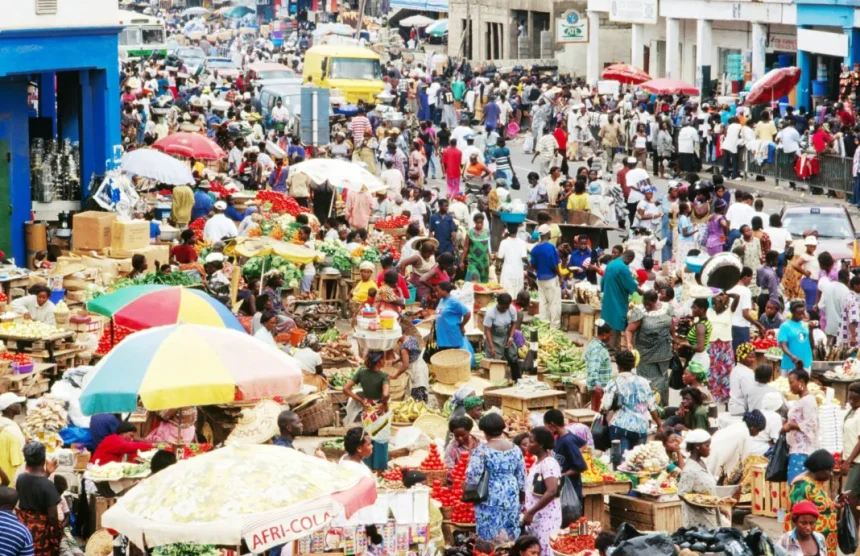
The bustling markets of Accra, especially Makola, Madina and Kantamanto, have long been the heartbeat of Ghana’s economy, but behind the vibrant displays of nicely-packed products and the rhythmic calls of hawkers lies a quiet and desperate struggle.
For many traders, the dream of sustaining a small business is being systematically dismantled by an opaque and predatory system of rent inflation and ‘goodwill’ payments.
Rising commercial rents, compounded by costly ‘goodwill’ claims and dollar-indexed pricing, are gutting profit margins for urban traders, as small businesses in Ghana’s prime retail markets struggle to absorb surging stall rental costs.
For small businesses, shop rental often represents the highest fixed cost, meaning even a modest increase erodes margins; hence, frequent rent inflation coupled with ‘goodwill’ demands by agents and landlords turns the situation into an unsustainable financial burden.
‘Goodwill’ in market centres usually refers to extra payments demanded by landlords or agents when a trader takes over a shop or stall.
It is often paid because the location already attracts strong customer traffic, especially if a well-known business previously operated or continues to operate there.
These claims are often arbitrary, non-transparent and add a high upfront cost to doing business.
While goodwill payments are meant to recognise the intangible value of a popular location and customer base, they frequently act as barriers to entry for new entrepreneurs.
The B&FT gathered from initial engagement with a former Accra Metropolitan Assembly (AMA) staff and some market women that officials of the assembly take goodwill payments from traders separate from the rent fees, before allowing, especially new entrants, the opportunity to occupy market stalls at Makola and its adjoining market spaces. This prompted an investigation into the practice and its impact on small shopkeepers’ businesses.
Whilst some mentioned AMA officials as involved in the practice, others were clear that the practice is usually carried out by the private entities managing the facilities.
Makola market and the hidden toll of new beginnings
The journey for a new trader often begins, not with the purchase of stock, but with a staggering upfront cost known as ‘goodwill’. At the Makola market, these payments are a haunting reality.
New entrants find themselves caught between official and unofficial bureaucracy and shadow middlemen.
Some traders accused AMA officials of demanding the non-transparent fees, while others pointed to private facility managers and agents, regardless, in many cases the goodwill payment is required before a tenant can take possession of a stall.
This arbitrary, non-receipted barrier to entry can reach as high as GH¢500,000 in prime spots, with one trader describing it as “the privilege of occupying a space that has already been made popular by the sweat of the trader before them or a strategically positioned new stall.”
A shop owner at Makola, SSNIT Mall, who prefers to be called Raman’s Madam, bought her shop for US$30,000 a few years back but has had to battle exchange rate volatility and organised group demonstrations to finally acquire the facility. Beyond that, she is paying monthly security, sanitation and property taxes, among other facility maintenance fees. These costs, she claims, justify the high rent charges for shops in the enclave.
Touching on the payment of goodwill, she said, “We all pay goodwill, and it is very expensive; you could be charged as high as GH¢500,000. Which is what I had to pay to get this place, so I paid a lump sum and spread the rest over a period and pay GH¢500 a month; others are also doing the same and this is different from the actual rent amount,” she said.
“Sometimes, we make losses, because after paying all these fees and paying your workers, the profit is gone, but we are surviving because some seasons bring in good sales that make up for the losses,” she added.
Fifteen years ago, a trader who prefers to be called ‘Rich’ walked into a shop in Makola, signing his first lease agreement for a five-year rent advance, calculated at a ‘manageable’ GH¢500 a month. It was a sacrifice he described as “a plunge into the unknown,” but it was a fair foundation upon which a humble business could be built. Today, that foundation has crumbled into a financial sinkhole. Rich’s rent now stands at GH¢6,000 a month, a mammoth 1,100 percent climb from his starting point.
When the payment model was restructured from yearly rent advance to monthly payment terms five years ago, he was forced to hand over a separate, non-refundable sum of GH¢50,000 simply for the right to keep the space he had nurtured for a decade. They called it ‘goodwill’, a term that felt like a cruel irony against the backdrop of his thinning profit margins.
A few blocks away, Nana Yaw, a dealer in women’s hair products, had two stalls five years ago with an ambition to expand to create an empire of beauty products. However, the relentless pressure of a GH¢70,000 annual rent as at the last renewal, forced him into retreat. He closed one shop, cramming all his inventory into a single unit, shrinking his footprint in a desperate bid to keep his business alive. “We are paying GH¢70,000 per year as rent. In addition, we pay taxes to the Ghana Revenue Authority (GRA) taxes, AMA levies and other facility maintenance fees. The rent system is obviously abnormal and something must be done about it,” he said.
Another trader, Collins, who has also occupied a stall for 20 years, indicated that every year, about GH¢1,500 to GH¢2,000 increment is added to the amount paid for rent the previous year, which is taken every month. His current annual rent is around GH¢67,000 excluding GRA taxes, Levies, VAT, among others.
On rent inflation, he said landlords routinely increase rents when the cedi weakens against the dollar but rarely reduce them when the currency strengthens. “To several traders, here at Makola, every year, when the management’s invoice arrives, it is like a wound that never heals, and as if that is not enough, the Ghana Revenue Authority (GRA) taxes, the AMA levies, and other facility maintenance fees, in addition to utility slices, eat away at their earnings until the profit is a ghost of what hard work should have yielded,” he said.
A notebook of fear at Kantamanto
In the narrow alleys of Kantamanto, the nation’s hub for second-hand clothing, the system is enforced with cold efficiency. Here, agents carry foolscap notebooks, the unofficial ledgers of the market. If your name is written in that book as having paid the unrecorded goodwill fee, you stay. If you refuse, you will be kicked out when your rent is due. And remember, there is always someone else in line, someone more desperate, waiting to take your place.
No official receipts are issued, no taxes recorded, just cash exchanged for the promise of a location. The bigger your vision, the steeper the price; a single shop commands a sum, a double shop a fortune, and a four-in-one unit a king’s ransom.
Derrick, who has been operating his business at Kantamanto for 15 years, indicated that the rent situation has been better since the market fire incident that happened last year, destroying almost everything. “Compared to other places, our monthly rent is now manageable, but we hope it will be maintained at this rate for at least five years so that we can recover from the fire incident,” he pleaded.
This environment has birthed a culture of silence. Many traders refused to speak to the B&FT’s investigators, even under the veil of anonymity. The fear of victimisation of losing the very stall that is keeping their children in school is more powerful than the desire for justice.
CMB market
At the CMB market, the financial pressure is a slow, monthly suffocation. Traders like Auntie Gina arrive at dawn and leave at dusk, six days a week, only to find their hard-earned gains swallowed by a relentless tide of payments. The math is brutal. Once the monthly rent is paid, the landlord’s commitment fee is settled, utility bills are covered, and the GRA takes its share, there is often nothing left for the person who did the actual work. “We are working hard but only for others to reap us off,” she lamented.
“Stalls at CMB also have a peculiar situation. Beyond the rent you pay to the owner, tenants are also to pay some monthly commitments to the landlord, about GH₵500, different from the levy that the assembly collects,” Auntie Gina alleged.
Madina market
In the Madina market, it was realised that the goodwill claimant is not popular, but inflated re-rent is the main challenge. Agents and middlemen and some market women procure the stalls from the assembly and rent them to third parties with exorbitant margins. “I got mine directly and the price was reasonable, but others occupy similar spaces that they got from agents and are paying almost double what I paid,” a market woman, who requested anonymity, said.
“A similar situation also happens with shops that do not belong to the assembly. The individual landlords give it to middlemen or agents who add extra to it without the knowledge of the owner,” she added.
In another facility around the Madina main station, Isaac explained that the stalls are under a management that determines the prices and ensures uniformity and conformity, hence everyone pays the same price, even though one needs to go through an agent who will take 10 percent commission from the person seeking to acquire the place. Touching on rent inflation, he said, “We should not narrow it to Madina, rent inflation in Accra is too high, very outrageous and so it’s difficult to survive. The government must really do something about rent inflation.”
Rent Control Department under the Ministry of Works and Housing inefficiency
Some traders lamented that the practice of taking five years rent advance for shops around Makola is a challenge for new entrants who want to occupy the place, which is why most are hawking on the streets, but the Rent Control Department (RCD) has not been able to help, even though they know about the situation.
The RCD demands someone to a formal complaint before they take action, but nobody is willing to do that because the moment you try that, you will be kicked out when your cover is blown and someone is already on standby willing to pay, Mr. Rich explained the challenge.
Raman’s Madam quizzed, “Rent Control is powerless because they do not own the shop. Some invested his money and wants five years rent to recoup it, who are you to tell him not to? I have been here for many years, the only time rent control did something helpful was when we demonstrated and reported about dollarisation of the shop purchases and they stepped in to negotiate with the company to fix the exchange rate on every two weeks term,” she added.
AMA denial
While officials from the AMA firmly deny any knowledge or revenue stream labelled ‘goodwill’ in their books, the traders speak of a more complex, layered reality. Some point to a system where private facility managers and middlemen have become gatekeepers, extracting these entrance fees that vanish into private pockets.
The AMA’s Public Relations Officer (PRO), Gilbert Ankrah, in an interview with the B&FT, responded that the assembly does not have any revenue stream dubbed ‘goodwill’ in its books and does not charge anyone such fees for the occupancy of its shops. “The AMA does not have anything in our books called goodwill and does not collect any revenue to that effect from shop occupants within the AMA territory,” he said. However, he indicated that some tenants of the AMA further rent the shop to third parties, increasing the rent and likely making goodwill claims as well.
Fear of victimisation
The fear of victimisation continues to remain a major hurdle for journalists in gathering primary information for their work in Ghana, and this one was no exception. The market women occupying Makola stalls, especially those who have paid the so-called goodwill money, are afraid to speak to reporters of the B&FT because of the fear of victimisation or ejection from the shops by their landlords.
Even on the condition of anonymity, some refused to speak completely, which was a challenge in getting numerous victims’ account backgrounds for this story. No one was willing to give up the contact of their shop owners, nor the agents who take the goodwill money.
Pathways to a fairer market
The current trajectory of Ghana’s retail markets is unsustainable. To protect the traders who serve as the backbone of the economy, several structural changes are required. The RCD must move beyond its complaint-only model. Proactive inspections and the enforcement of the legal limit on rent advances (currently six months) would provide immediate relief to those being asked for five years of payment up front.
The current notebook system of goodwill collection allows for massive tax evasion by landlords and extortion of tenants. Urgent steps must be taken by the GRA and the Bureau of National Investigations (BNI) to identify these extortionists and bring them to book. Furthermore, the government must strictly enforce laws against the pricing of local commercial rents in foreign currencies to protect traders from the volatility of the exchange rate.
Municipal Assemblies should eliminate the role of the middleman by ensuring that stall leases are non-transferable and issued directly to the person actually occupying the shop. Until these steps are taken, women like Auntie Gina Raman’s Madam and men like Rich, Nana Yaw, Collins, etc., will continue to work from dawn to dusk, not to build a future for themselves, but to feed a system that views their survival as an afterthought.