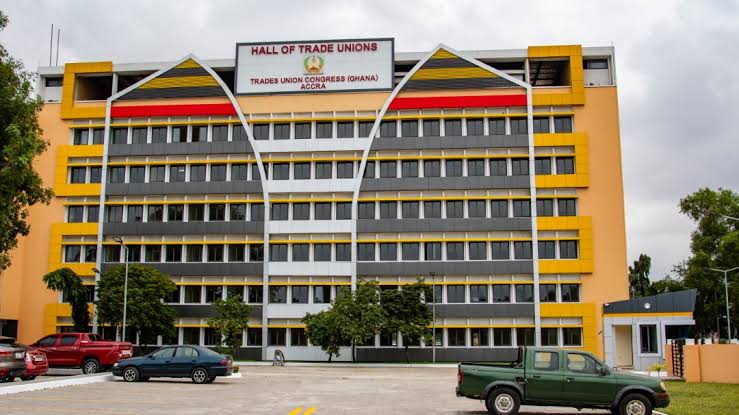
The Trades Union Congress (TUC)-Ghana has rejected the World Bank’s proposal to introduce private sector participation (PSP) in the operations of the Electricity Company of Ghana (ECG) and the Northern Electricity Distribution Company (NEDCo).
The union accused the World Bank of being “disingenuous” about the proposed arrangement and warned that it would resist any attempt to privatise Ghana’s electricity distribution sector.
The TUC, in a statement issued in September 2026, challenged comments by the World Bank’s Country Director, Dr Adrian Alter, who said on Channel One Television on August 24 that the proposed PSP involved “only revenue collection.”
The union said the description does not reflect the model proposed by the Transaction Advisor appointed at the instance of the World Bank and the International Monetary Fund (IMF).
“Contrary to the Bank’s explanation, the Transaction Advisor appointed at the instance of the Bank and its sister institution, the IMF, has proposed a model in which private operators will assume responsibility for electricity distribution from the Bulk Supply Points to the final customer,” the union said.
Under the proposed model, ECG and NEDCo would retain ownership of their distribution assets, while private operators would lease and operate the networks.
The private operators would handle billing, revenue collection, customer management, network maintenance, loss reduction and other technical and commercial activities.
“The World Bank is aware of this model. It is shocking for the Bank to say otherwise. And it is even more disingenuous for the Bank to claim that ECG is not going to be privatised,” the TUC stated.
The union also questioned whether private sector involvement would necessarily improve electricity access, particularly in rural areas.
It cited electricity access figures from countries including Egypt, Tunisia, Algeria, Ghana, South Africa, Kenya and Rwanda, which it said had higher rural access rates than Nigeria and Uganda, where private companies have taken over distribution.
The TUC further criticised the Independent Power Producer (IPP) model, arguing that it has contributed to Ghana’s high electricity generation costs and foreign-exchange exposure.
“The Bank will have us believe that the IPP model of procuring generation is the only game in town and that Ghana cannot do without it. This is a lie. There are better alternatives,” the TUC stated.
The union also recalled Ghana’s experience with privatisation under the Structural Adjustment Programme, saying World Bank-supported reforms led to the privatisation of more than 100 state-owned enterprises and resulted in significant job losses.
It insisted that decisions on strategic energy assets must remain under Ghanaian control.
“We did not vote for the World Bank to run our country and, for that matter, our energy distribution sector,” the union stated.
The TUC said it would use all legal means available to stop the proposed arrangement, maintaining that PSP and privatisation are effectively the same.
“We regard PSP and Privatisation as one and the same and that the TUC and its affiliates are intensely opposed to the privatisation of Ghana’s electricity distribution sector,” it stated.