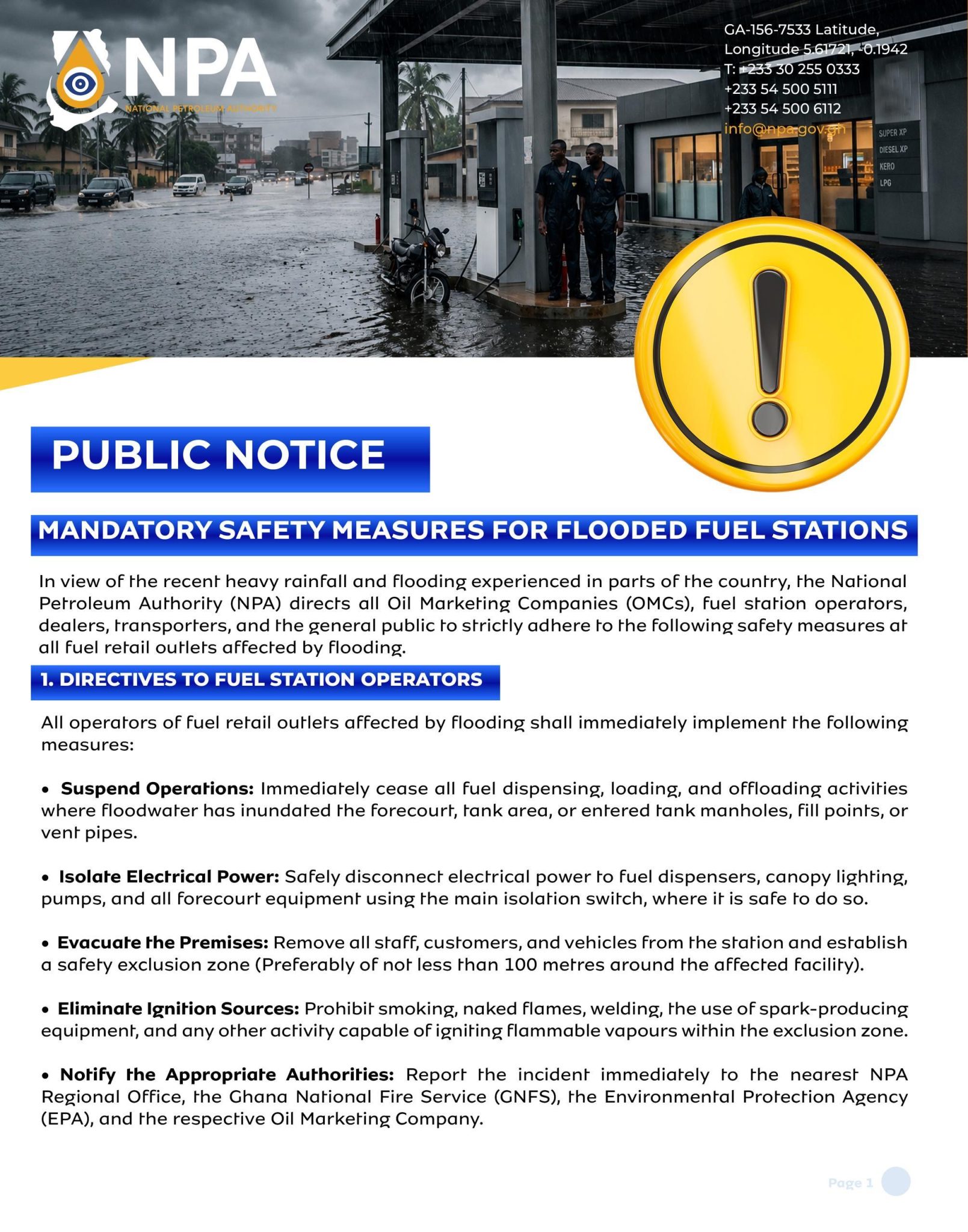
The National Petroleum Authority (NPA) has mandated that all Oil Marketing Companies (OMCs), fuel station operators, dealers, and transporters enforce essential safety protocols at fuel stations impacted by flooding.
The NPA cautions that failure to comply may result in regulatory penalties and legal action.
This directive comes in response to significant rainfall and flooding in various regions of the country, raising alarms about the potential for fuel contamination, fires, explosions, and environmental damage.
In a public announcement, the regulator instructed operators of flooded fuel stations to promptly halt all fuel dispensing, loading, and offloading operations in areas where floodwaters have submerged the forecourt, tank zones, or infiltrated underground fuel storage facilities.
The NPA also ordered operators to disconnect electrical power to pumps, fuel dispensers, canopy lighting, and other forecourt apparatus where it is safe to do so, while ensuring the evacuation of all personnel, customers, and vehicles from the affected stations.
Additionally, operators have been directed to create a safety exclusion zone of at least 100 meters around the impacted facilities.
As part of the emergency protocols, the Authority has banned smoking, open flames, welding, and any activities that could produce sparks within the exclusion zone.
Furthermore, operators are required to immediately inform the nearest NPA Regional Office, the Ghana National Fire Service (GNFS), the Environmental Protection Agency (EPA), and their respective Oil Marketing Companies.
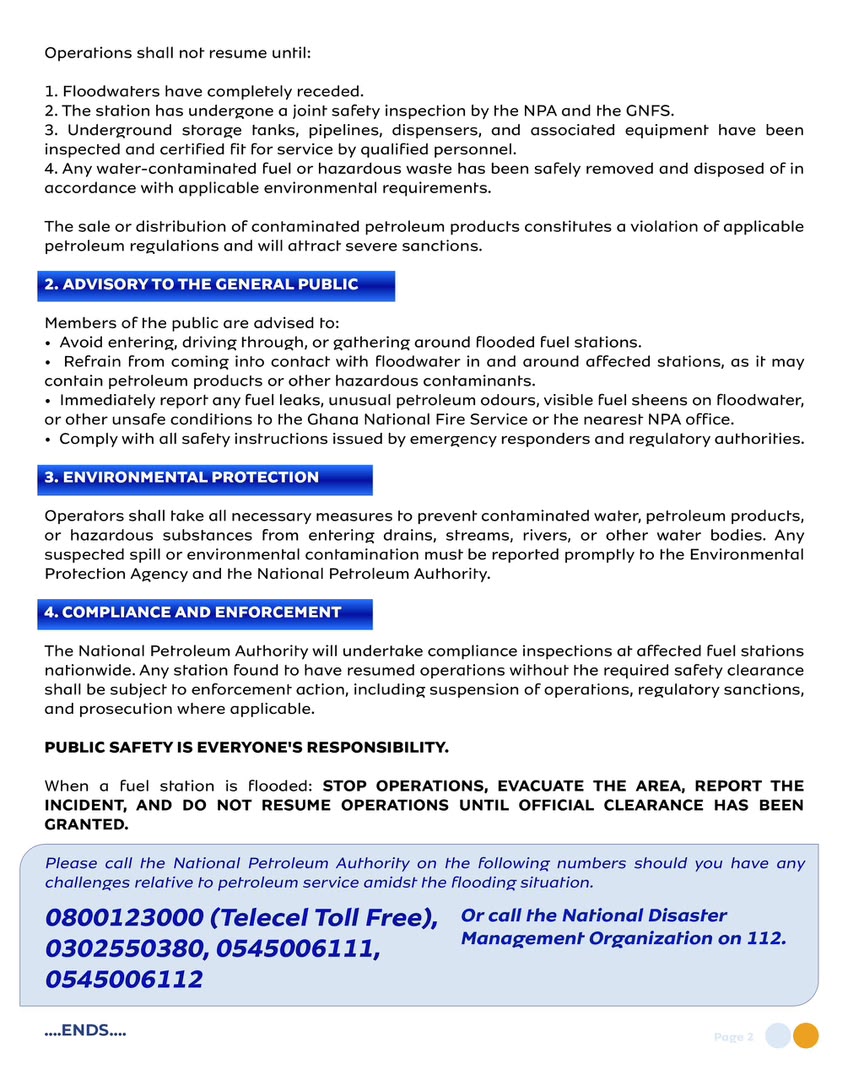
The NPA has stated that fuel stations affected by flooding will not be allowed to resume operations until several safety conditions have been fulfilled.
These conditions include the complete withdrawal of floodwaters, a joint safety assessment by the NPA and the Ghana National Fire Service, and certification by qualified personnel that underground storage tanks, pipelines, fuel dispensers, and related equipment are safe for use.
Operators are required to ensure that any water-contaminated fuel or hazardous waste is appropriately removed and disposed of in full compliance with environmental regulations.
The Authority cautioned that the sale or distribution of contaminated petroleum products constitutes a breach of petroleum regulations and will attract severe sanctions.
Additionally, the NPA issued a public advisory, urging motorists and residents to avoid entering, driving through or gathering around flooded fuel stations.
It warned against coming into contact with floodwater around affected facilities, noting that such water may contain petroleum products or other hazardous contaminants.
The Authority further encouraged members of the public to immediately report fuel leaks, unusual petroleum odours, visible fuel sheens on floodwater or any other unsafe conditions to the Ghana National Fire Service or the nearest NPA office, while complying with instructions from emergency responders.
Find the full statement below.