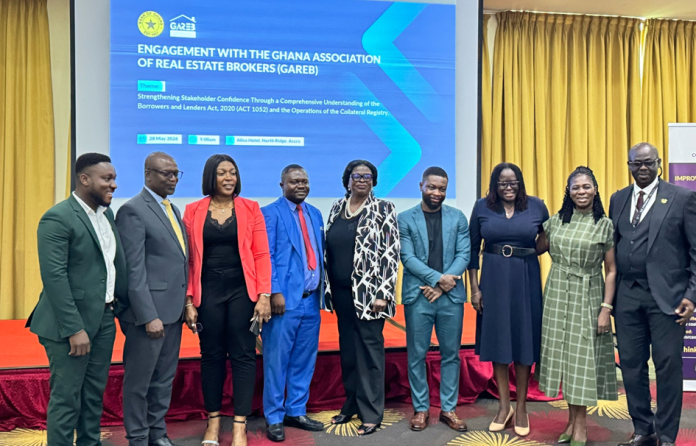
The Bank of Ghana and Ghana Association of Real Estate Brokers (GAREB) are intensifying efforts to strengthen due diligence in property transactions as regulators and industry players seek to reduce fraud risks, improve transparency and reinforce confidence in Ghana’s real estate and credit markets.
At an industry engagement on operations of the central bank’s Collateral Registry, officials said stronger use of property searches and verification systems will help prevent the sale or marketing of assets already pledged as collateral for loans.
Rosemary Akabutu, Deputy Head-Collateral Registry Department, Bank of Ghana, said the Borrowers and Lenders Act 2020 (Act 1052) and establishment of the Collateral Registry were introduced to address structural weaknesses in Ghana’s credit market, including information asymmetry, weak enforcement systems and elevated lending risks.
She said the reforms were aimed at strengthening confidence in secured lending by providing legal guidance on the registration, priority and enforcement of security interests in both movable and immovable assets.
“In the real estate industry, the importance of conducting searches and understanding any existing encumbrances on assets cannot be overemphasised,” Ms. Akabutu said on behalf Head and Registrar of the Collateral Registry, Mr. Fred Asiamah-Koranteng. “These are vital steps in minimising risk, preventing fraud and safeguarding investments.”
The central bank said limited public awareness remains a challenge despite the collateral registry reforms having been in place for more than a decade. The Bank of Ghana has therefore expanded financial literacy and stakeholder outreach programmes to improve understanding of the registry system and broader secured transactions framework.
The engagement comes as Ghana’s property sector faces increasing scrutiny over fraud, unlicenced brokerage activities and disputes linked to land ownership and collateralised properties.
GAREB president Jacob Ansong said brokers increasingly recognise that real estate transactions now require stronger professional standards and more rigorous verification procedures beyond simply matching buyers and sellers.
“Our duty is to conduct searches and do a lot of due diligence on properties – sometimes properties have been used as collateral but we are not aware,” Mr. Ansong said in an interview on the programme’s sidelines. “So before we put any property on the market, it is our responsibility to know whether or not it has been used for that purpose.”
He said the association engaged the central bank specifically to train brokers on how to conduct searches through the collateral registry system to reduce the risk of disputed or improperly marketed properties.
The discussions also highlighted broader regulatory reforms in Ghana’s real estate industry following passage of the Real Estate Agency Act 2020 (Act 1047), which established the Real Estate Agency Council as the sector’s legal regulator.
Mr. Ansong said the industry has historically operated with limited oversight, allowing unlicenced operators to flourish and exposing consumers to fraud and financial losses. Under the current law, agents and brokers are required to be licenced and subject to regulatory oversight and disciplinary procedures.
“In coming days, the Council will intensify its monitoring and enforcement activities,” he said, adding that inspecting firms and operators will increase to curb illegal practices.
The push for tighter verification standards and licencing enforcement reflects broader efforts to formalise Ghana’s property market as demand for housing and real estate investment continues to rise. Industry players say improved transparency and reliable property records could also strengthen access to mortgage financing and reduce risks within the banking sector.
Mr. Ansong however argued that Ghana’s housing challenge is increasingly an affordability problem rather than a pure supply deficit.
“As we talk about a 1.8 million to 2 million housing deficit, there are about 1.5 million houses lying vacant,” he said. “The problem is cost, the price. It is not affordable for Ghanaians.”