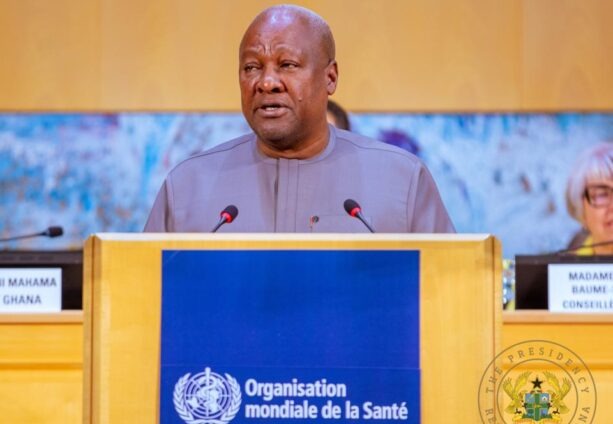
President John Dramani Mahama has revealed that Ghana has lost around US$78 million in health support after cuts to several United States aid programmes.
He explained that the reduction has affected key health areas such as malaria control, HIV/AIDS treatment, maternal care, nutrition, HIV testing, and the supply of antiretroviral medicines.
He made these remarks on May 18, 2026, while speaking at the 79th World Health Assembly in Geneva. He noted that the drop in donor funding has increased pressure on Ghana’s healthcare system.
According to him, the situation has stretched critical services that many people depend on for survival.
President Mahama argued that African countries must now invest more in their own health systems instead of relying heavily on external support.
He said, “The old system of donor dependency is past its sell-by date,” while addressing delegates at the assembly.
He also pointed out that the reduction in aid from Western partners has disrupted health financing across Africa. In his view, this situation has exposed structural weaknesses in many national health systems.
He added that the World Health Organization had scaled down some of its programmes and reduced staff after the withdrawal of US assistance.
He further warned that these funding cuts could push about 5.7 million people across the continent into poverty by the end of 2026.
To respond to these challenges, the President said the Ghanaian government has increased domestic funding for healthcare.
He explained that removing the cap on the National Health Insurance Fund unlocked an additional GH¢3 billion for health spending. He also noted that the 2026 national budget set aside GH¢34 billion for the health sector.
Mahama added that the government is now using digital tools, including artificial intelligence, to detect and reduce fraudulent claims under the National Health Insurance Scheme.
He also said Ghana has begun rolling out a free primary healthcare programme to improve access to basic medical services, especially in rural areas.
He stated that the National Health Insurance Scheme currently covers about 66 per cent of Ghanaians, leaving roughly one-third without coverage.
He also said Ghana is working to reduce its reliance on vaccine support programmes and aims to stop depending on Gavi assistance by 2030.