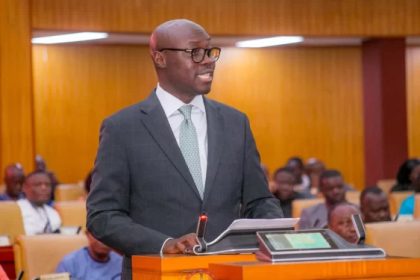

The Majority Chief Whip, Rockson-Nelson Dafeamekpor, says the Independent Examinations Committee (IEC) no longer has the legal power to conduct entrance exams for admission into law schools under Ghana’s newly approved legal education law.
His remarks come after President John Dramani Mahama signed the Legal Education Reform Bill, 2025, into law.
The new legislation ends the 66-year exclusive control of the Ghana School of Law over professional legal training in the country.
On Tuesday, May 12, Mr Dafeamekpor addressed one of the major debates around the reform, whether prospective students would still be required to write entrance examinations before entering law school.
He explained that the new law has removed entrance examinations entirely for admission into law schools in Ghana.
According to him, Section 90 of the law, which deals with transitional arrangements, cancels Legislative Instrument 2355 of 2018.
That regulation previously gave the IEC the authority to organise entrance exams for students seeking admission into the Ghana School of Law.
Mr Dafeamekpor said once those provisions were repealed, the IEC automatically lost any legal basis to continue conducting such examinations.
He also criticised individuals and institutions that are still organising preparatory classes for aspiring law students based on the assumption that entrance exams will take place.
He insisted that the current law makes no provision for those exams.
He added that Section 45 of the new legislation now clearly outlines the requirements for admission into law schools.
Mr Dafeamekpor further stated that the admission process will now follow a standard system across all law schools in Ghana. The Council for Legal Education and Training will oversee the admission criteria.
The law also allows accredited universities to run professional legal education programmes. Many stakeholders had pushed for this change, arguing that the previous arrangement created unnecessary obstacles for people who wanted to enter the legal profession.
President Mahama, who assented to the bill on Monday, May 11, 2026, said the reform aims to preserve standards while making legal education more accessible to a wider range of people.