China has displaced the United States on an influential ranking of the world’s fastest supercomputers, underscoring Beijing’s growing capability to compete with the world’s leading superpower in cutting-edge technology.
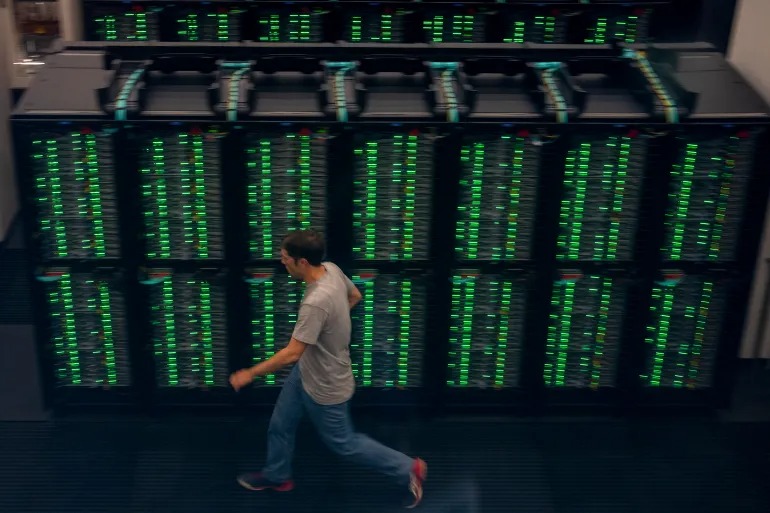
China’s LineShine is the most powerful system on the planet, overtaking the US-based El Capitan, according to the biannual ranking announced in Hamburg, Germany, on Tuesday.
LineShine, located at the National Supercomputing Centre in Shenzhen, achieved a performance of 2.198 exaflops, carrying out more than 2 quintillion calculations per second – a 20 percent lead over El Capitan, according to the latest TOP500 list.
LineShine’s position marks the first time a Chinese system has topped the list since Sunway TaihuLight did so in 2017.
El Capitan, based at Lawrence Livermore National Laboratory in Livermore, California, had ranked as the top-performing system since November 2024.
Frontier at the Oak Ridge National Laboratory in Oak Ridge, Tennessee, ranked third, followed by Aurora at the Argonne National Laboratory in Downers Grove Township, Illinois, and Jupiter at the Julich Supercomputing Centre in Julich, Germany.
Other countries represented in the top 20 included the United Kingdom, Japan, South Korea, Italy, the Netherlands and Switzerland.
Jack Dongarra, an emeritus professor of computer science at the University of Tennessee who is one of the organisers of the TOP500 list, said LineShine’s performance showed China to be capable of holding its own in advanced computing despite US export restrictions on the most advanced chips.
“Export controls may slow China’s access to certain advanced components, but they also provide a strong incentive to develop domestic alternatives,” Dongarra told Al Jazeera, adding that he was “not entirely surprised” that China had taken the lead.
“LineShine suggests that China has responded through large-scale investment and hardware-software codesign,” Dongarra said.
“In the longer term, controls may both constrain China and accelerate its efforts to become technologically self-sufficient.”
Unlike other supercomputers, LineShine runs entirely on general-purpose central processing units (CPUs), which have fewer processing cores and are slower at performing complex tasks than the graphics processing units (GPUs) indispensable to running artificial intelligence models such as ChatGPT and Claude.
LineShine is the first and only system to achieve more than 2 exaflops in performance using a CPU-only design, according to the TOP500 list.
The list has been published twice yearly since 1993 when computer scientists Erich Strohmaier and Hans Meuer first compiled statistics on supercomputers around the world in preparation for a conference on the topic.
The list ranks supercomputers’ performance using the LINPACK Benchmark, which measures the amount of time it takes to solve a dense system of linear equations.
China-based supercomputers once dominated the list, taking up nearly half the spots in 2019, but Chinese participation in the ranking dwindled in recent years amid souring relations between Washington and Beijing.
While the TOP500 list has been influential for decades, some experts consider the project to have become less relevant in recent years due to changes in computing processes since the advent of AI.
Although corporate tech giants such as Microsoft, Amazon, Meta and Alphabet are at the forefront of today’s advances in AI, the TOP500 list is largely made up of government and academic initiatives that volunteered to participate in the ranking.