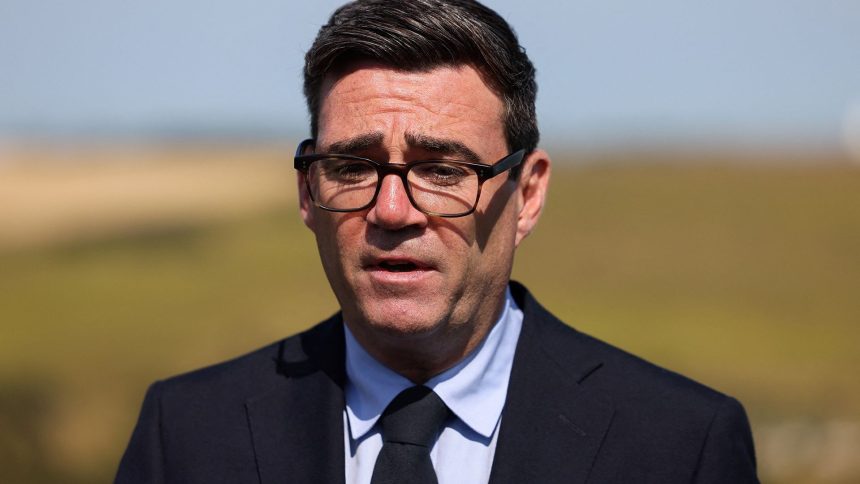
Andy Burnham has pledged his government will be “relentless” in curbing the number of people arriving in the UK on small boats.
The prime minister said progress had been made and the government was “changing the whole approach”, with enforcement officers tackling people-smuggling gangs doubled on both sides of the Channel.
“People want to see this issue addressed,” he said in Dover, adding: “We also need to build a system that offers safe routes for people as well, because that also takes away the selling point of the gangs.”
The Conservatives said that Labour had not delivered on its promises on migration, while Reform UK said if in government it would deploy the navy to ward off crossings.
Political discussions around the UK’s policies on illegal migration have resurfaced since tens of thousands of migrants swam into the Spanish exclave of Ceuta on Thursday.
Burnham noted that 98% of the people who swam to the African territory had been returned to Morocco – which he said had dealt with the immediate issue.
But he added: “There’s a broader issue about the Schengen area and our relationship with it, and of course, I would want to be in regular dialogue with the EU on those issues.”
His comments came shortly after the Home Office announced that the number of National Crime Agency (NCA) officers tackling smuggling gangs facilitating small boat crossings had risen to almost 800 from 376 at the start of 2025.
Burnham said there had been a similar doubling of French officers.
Asked whether he wanted to change the tone of the debate around small boats, he said that he wanted to “deal with the issue rather than play politics with the issue”.
He added: “The public don’t like the idea that the border looks like it’s not controlled. We need to bring back that control. But also we need to offer support for people who genuinely need it.”
The Home Office also said on Sunday that there had been nearly 300 arrests of smuggling gang members last year, as well as the seizure of more than 1,100 small boats and engines.
It said that, if the equipment seized by the NCA had been used, it could have helped 72,000 more people come illegally to the UK. The BBC has been unable to independently verify this claim.
“Clearly, progress is being made, but we’re not complacent,” Burnham commented.
Reform UK home affairs spokesman Zia Yusuf said his party would order the navy to force small boats carrying migrants back to France, saying it would be “the largest military operation in the English Channel since World War Two”.
The plan – set to be released in full at a conference on Monday – has been endorsed by “former senior members of our armed forces”, Yusuf told the Today programme.
International conventions on the sea allow for states to pick people up from boats if they are in danger of being lost but do not allow for them to be taken to another country without that nation’s consent.
Yusuf accepted that the UK and France may have “a diplomatic argument” if French authorities were to refuse to accept migrants escorted back to its shores, but insisted they have a “commitment under international law” to process migrants.
Retired Royal Navy commander Tom Sharpe suggested Reform’s plan “lacks quite a lot of substance”.
“We have the border force already to do this,” he told the BBC’s Today programme, adding that warships designed for anti-submarine defences “are not best used for ferrying people around”.
“You’re better off using an actual ferry,” he said.
A Labour Party spokesperson said Reform’s plans were a “desperate bid” to distract from scrutiny of their party’s finances.
Reacting on BBC Breakfast, shadow home secretary Chris Philp repeated calls for the UK to leave the European Convention on Human Rights.
“That would enable us to deport every single illegal immigrant within a week of arrival,” he said. “Either back to their country of origin if possible, or a safe third country, for example Rwanda, if not.”
He said this would bring a “deterrent effect” as migrants would no longer cross the channel if they knew they would be deported straight away.
The Liberal Democrats’ immigration and asylum spokesman Will Forster said the government should “redouble its efforts to rebuild our broken relationship with Europe” and “continue to cut down on the asylum backlog”.
The prime minister was shown a small boat during a visit to Dover’s joint command room
The number of migrants who have arrived in the UK on small boats since Burnham became PM a fortnight ago surpassed 2,000 after 326 people crossed the English Channel on Saturday.
More people attempt the potentially perilous crossing in the summer when conditions are better, and Home Office figures show small boat crossings so far this year are down around 43% compared to the same period in 2025.
Small boat crossings have become the most common way for people to be detected entering the UK illegally since 2020, and the issue has become a lightning rod in the wider debate over immigration.
The number of small boats crossing the Channel have been on a downward trend since it peaked in 2022, Home Office figures show.
In May, the Office for National Statistics (ONS) revealed that net migration to the UK fell to 171,000 last year – almost half the number seen in 2024 when Labour assumed power, and the lowest level since 2012.
The drop has been attributed to fewer people arriving from outside the EU for work and study.