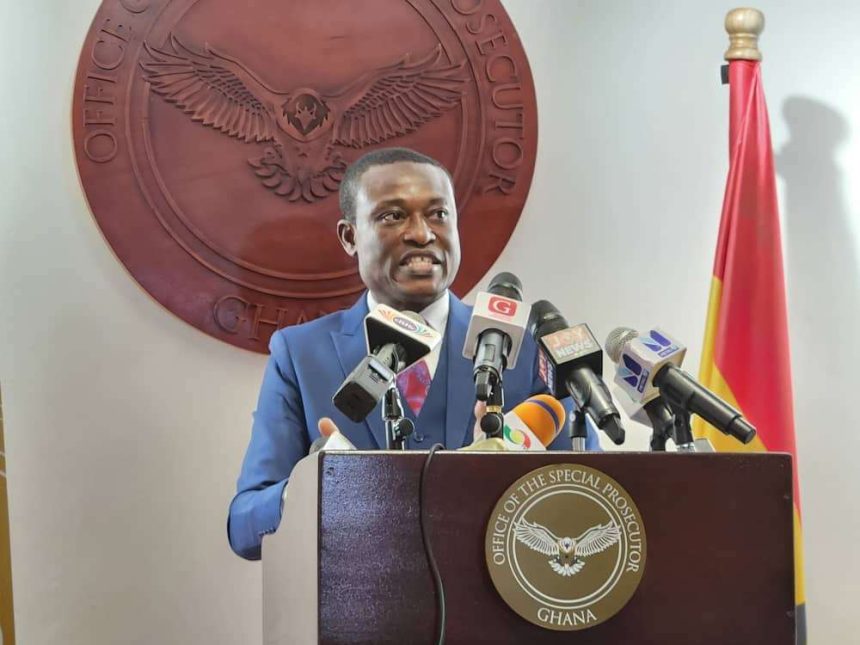
An Accra High Court has ruled that the Office of the Special Prosecutor (OSP) does not have the independent authority to prosecute criminal cases.
Presiding judge Justice John Eugene Nyadu Nyante stated that while the OSP has the power to investigate corruption-related offences, it does not have the constitutional authority to prosecute them on its own.
The court based its decision on Article 88 of the 1992 Constitution, which assigns prosecutorial powers exclusively to the Attorney-General.
The court then directed that all cases initiated by the anti-corruption body must be handled by the Attorney-General’s Department.
The ruling, delivered on Wednesday, April 15, 2026, has created uncertainty around ongoing OSP prosecutions, effectively putting them on hold until further legal guidance is provided.
The case arose from an application for quo warranto filed by Peter Achibold Hyde, who questioned the OSP’s legal authority to carry out prosecutions.
In response, the OSP strongly criticised the ruling, arguing that the High Court had gone beyond its jurisdiction. In a statement issued shortly after the decision, the agency said it had begun steps to challenge the ruling at the appropriate legal forum.
“The OSP states that it is taking steps to quickly overturn the decision of the General Jurisdiction Court since the High Court does not have jurisdiction to, in effect, strike down parts of an Act of Parliament as unconstitutional. It is only the Supreme Court which can strike down parts of an Act of Parliament as unconstitutional,” the OSP stated.
The ruling is likely to spark major legal debate over the scope of the OSP’s mandate and how corruption cases are prosecuted in Ghana.
It also adds to existing uncertainty, as a separate case before the Supreme Court is already challenging the OSP’s authority to prosecute.
The case, filed by Noah Ephraem Tetteh Adamtey, questions whether Parliament acted constitutionally in granting the OSP independent prosecutorial powers.
Notably, the Attorney-General’s Office supports this challenge, arguing that allowing the OSP to prosecute without its approval may violate Article 88 of the Constitution.
Legal experts say the Supreme Court’s decision could have far-reaching consequences, potentially redefining the OSP’s role and the future of anti-corruption prosecutions in Ghana.