Custodianship beyond land sales: What Ghana’s law require of traditional authorities.
Why chiefs and customary land custodians must help protect communities from flooding, unplanned development
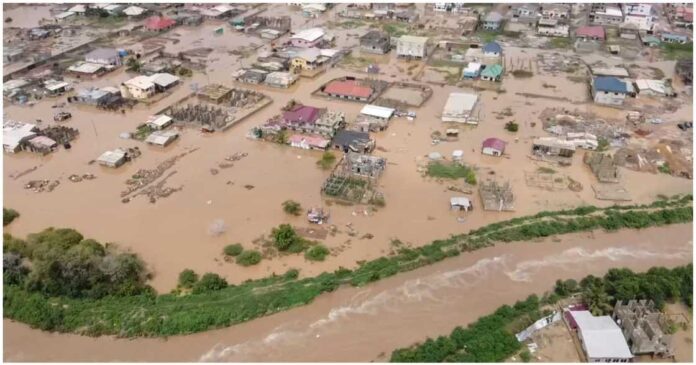
As the rains subside, the effects of flooding remain: flooded homes, blocked drains and destroyed waterways.
This shows that flooding is not only about heavy rainfall, but also about how land is managed and developed.
Lasting solutions must therefore go beyond drains and emergency responses to address the institutions that influence land allocation.
Traditional authorities, as custodians of large portions of Ghana’s customary lands, are key stakeholders.
Many development decisions begin with land allocation. A parcel allocated today can create problems for decades.
When waterways, drainage corridors, road reservations or environmentally sensitive areas are wrongly allocated and developed, communities and the State eventually bear the cost.
Chiefs undoubtedly have a part in land administration; thus, to fulfill that role in order to save future generations, preserve the environment, and encourage orderly development.
Land custodianship comes with responsibility
Traditional authorities are not merely landowners or sellers; they hold customary lands in trust for their people.
Article 267(1) of the 1992 Constitution vests stool lands in the appropriate stool “on behalf of, and in trust for” its subjects, while Article 36(8) requires such lands to be managed for the people’s benefit.
Section 13(2) of the Land Act, 2020 (Act 1036) similarly makes customary land authorities fiduciaries, while section 13(3) requires transparency, fairness and impartiality.
Land decisions must therefore prioritise long-term community interests over immediate financial gain.
Plan before disposing of land
Section 74 of the Land Use and Spatial Planning Act, 2016 (Act 925) requires a Local Plan to be prepared before plots from a large tract of land are disposed of, where the District Spatial Planning Committee considers one necessary.
The plan must be prepared by a qualified planner and approved before disposal.
This ensures that roads, drainage, schools, open spaces, waterways and environmentally sensitive areas are properly considered. Sections 72 and 73 also promote the judicious, orderly and environmentally sound use of land.
Traditional authorities should therefore view spatial planning as a tool for protecting communities and ensuring sustainable development.
Check before you allocate
Before allocating land, traditional authorities should ask: What is the land zoned for? Is there an approved Local Plan? Is it reserved for a road, drainage, school, market or park? Is it a wetland, waterway or flood-prone area? Section 79 of Act 925 requires development in areas covered by an approved Local Plan to conform to it.
Land that appears vacant may therefore have an important planned purpose.
A land allocation is not permission to build
Acquiring or registering an interest in land does not automatically permit construction. Section 113(1) of Act 925 requires a development permit from the District Assembly before physical development.
Where rezoning or a change of use is sought, section 93 requires an application supported by a professional planner’s report.
Traditional authorities should therefore make clear that land ownership and development permission are separate legal requirements.
Protect waterways, roads and public facilities
Flooding shows why land allocation and planning must go together. Streams and waterways that appear small during the dry season can become vital drainage routes during heavy rains.
When they are blocked or built upon, water often flows through homes and roads. Section 19 of the Land Act, 2020 (Act 1036) provides for areas to be set aside for common use, including water bodies.
Traditional authorities should therefore help protect waterways, wetlands, drainage corridors and flood-prone areas, using their local knowledge to support proper planning.
Reserved land for roads, schools and other public facilities should not be allocated for private development.
Customary Land Secretariats and partnership in planning
Sections 14 and 15 of Act 1036, provide for Customary Land Secretariats to maintain land records, provide information, educate communities and support participatory Local Plan preparation.
They should help establish not only who owns land, but its planning status and public reservations.
Traditional authorities’ knowledge of boundaries, settlements, streams and flooding is valuable. Section 15(1)(e) therefore provides for their participation in Local Plan preparation and review.
A simple principle and the legacy we leave
Responsible land administration requires land to be planned and its status verified before allocation, registration and development.
The reverse, which is: allocate, register, build and then discover problems; must be avoided.
Before disposing of plots from large tracts requiring a Local Plan, section 74 of Act 925 must be followed.
Before development begins, a permit is required under section 113, while section 93 applies where a change of use is sought.
Environmentally sensitive areas and land reserved for public purposes must also be protected.
Traditional leadership should be measured not only by plots allocated or revenue generated, but by communities with functioning waterways, protected roads, schools, markets, wetlands and public spaces.
Traditional authorities are custodians of their communities’ future. They should work with professional planners and Customary Land Secretariats to ensure that land is planned, verified and responsibly allocated.
Before you dispose of land, plan it. Before you allocate it, verify it. Before development begins, obtain the required permit. Protect what must remain protected; and think beyond today’s transaction to tomorrow’s community.
The writer, Samuel Ansong is the Head of Physical Planning Department of the Kwahu East District Assembly and National Secretary of the Local Government Service Association of Physical Planners