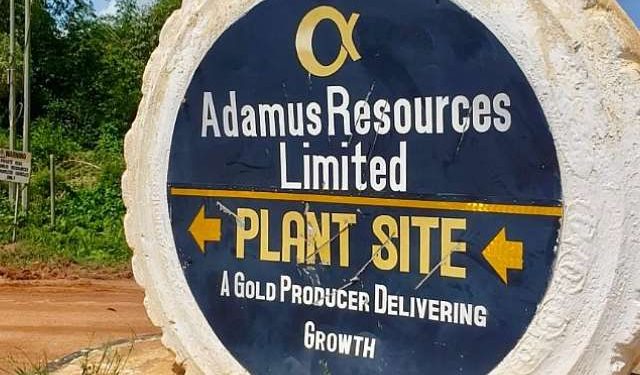
The Government decision to establish a 12-month roadmap to turn around Adamus Resources marks a significant development in the dispute surrounding the mining company, and an important outcome of the policy dialogue initiated by IMANI with the Ministry of Lands and Natural Resources.
During IMANI’s engagement with the Ministry, the government made its position clear. The Lands and Natural Resources Minister, Hon. Emmanuel Armah-Kofi Buah defended the regulatory action taken against Adamus, stressing that no mining company, regardless of its size or influence, should operate outside Ghana’s laws and regulatory framework.
IMANI agreed on the importance of regulatory discipline. But we also argued that enforcement and investor protection should not be treated as mutually exclusive.
Franklin Cudjoe, Founding President of IMANI, urged the Minister to consider a structured pathway through which Adamus could address the concerns raised by regulators, meet its obligations and work towards restoring its operations under an appropriate framework.
The Minister responded positively to the proposal, indicating that government would be willing to engage where the company demonstrated a genuine commitment to making the necessary corrections.
The subsequent intervention by the Presidency has now given that principle a concrete institutional form.
Under the arrangement announced on Friday, 21st August 2026, the Ministry, the Minerals Commission and Adamus Resources will develop a 12-month roadmap for the turnaround of the mine. A six-member management team, comprising three representatives from government and three from Adamus, will oversee the process.
The roadmap will also address Adamus’ liabilities to the Ghana Revenue Authority, the Minerals Income Investment Fund, financial institutions and suppliers, while exploring the injection of fresh capital through additional equity partners.
The significance of this development goes beyond Adamus.
For IMANI, it demonstrates the value of independent policy engagement that does not merely criticise government, but enters the policy space with evidence, questions and workable alternatives. Our intervention was grounded in a simple proposition: Ghana can enforce its laws firmly while still creating a fair and predictable pathway for legitimate investment to correct remediable deficiencies and continue creating economic value.
The Presidency’s decision reflects a meaningful movement in that direction.
It also reinforces an important principle about IMANI’s role in Ghana’s policy environment. Independence does not mean opposing government for its own sake. It means being willing to challenge government when necessary, propose better alternatives and acknowledge progress when policymakers respond constructively.
Following the announcement, Franklin Cudjoe expressed his appreciation to the President and the Lands Minister, saying:
“Thank you President Mahama. You are a true builder of nation. Thanks my dear Minister of Lands & Natural Hon. Buah, your patience and humility are always your greatest assets.”
The public response has similarly recognised the role of independent thinking in the process. One reaction captured it succinctly: “When IMANI is involved this nation will think.” Another called for governments to “think ahead, not thought behind”, while a further reaction described IMANI’s strength as its willingness to “speak truth to power” regardless of who is in office.
For us at IMANI, that is precisely the point.
Policy influence is not about winning arguments for their own sake. It is about helping Ghana make better decisions.
The Adamus engagement shows what can happen when independent analysis meets an open policy dialogue: a difficult dispute can move from confrontation towards a structured pathway for resolution.
The work, however, does not end with the announcement. The success of the 12-month roadmap will depend on implementation, accountability and measurable results. IMANI will continue to watch that process closely.
Our commitment remains unchanged; to challenge, engage and advocate for policies that advance Ghana’s institutional strength, economic opportunity and long-term national interest.