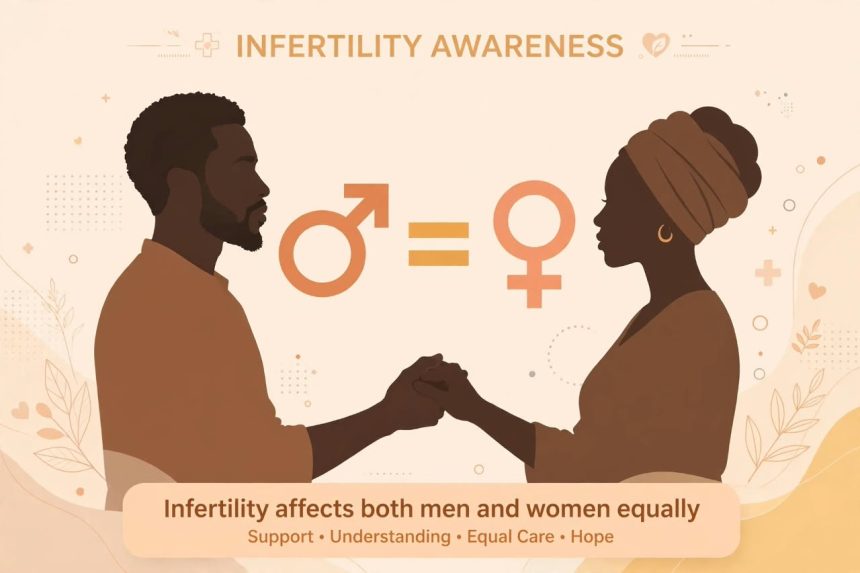
The media, community and religious leaders must do more to curb the stigmatisation of childless couples and improve education on infertility, a Public Health Practitioner has said.
In an interview with Dr. Owusu Yankyera, he said the media should not downplay the role their platforms can play in addressing the issue.
“Using their various platforms to address infertility will help people better appreciate the devastating effect of blaming and name-calling one or both partners. It will also give couples hope not to give up the fight in seeking help,” he stated.
He said community and religious leaders also have a critical role to play because their members hold them in high esteem and their words carry weight.
“These are people who hold their members in high esteem and whose words carry weight. Leaders should leverage that influence to advocate against the stigma of childlessness and to educate their communities on infertility,” he added.
It affects both men and women equally
Dr. Yankyera said the long-held belief that only women can be infertile is worsening Ghana’s infertility problem.

“Society must change how it talks about childlessness. Infertility is a medical condition, not a curse or a sign of failure, and it affects both men and women equally,” the Public Health Practitioner said.
He defined infertility as the inability to conceive after one year of regular unprotected intercourse and expressed concern that many couples panic just a few months into marriage, oblivious of what actually constitutes infertility.
“One-third of the time the problem lies with the male, one-third of the time it lies with the female, and one-third of the time infertility is caused by problems with both the male and the female,” he stated.
For women, he said, causes can include hormonal problems, ovulation issues, fibroids, blocked fallopian tubes, cervical problems and stress. For men, common causes include low sperm count, varicocele, infections such as gonorrhea, mumps-related orchitis, diabetes, and lifestyle factors Dr. Yankyera disclosed.

“Conception is a complicated process. It requires healthy sperm, healthy eggs, open tubes, fertilisation and implantation. Anything can go wrong along the line for either partner,” he explained.
The danger of stigma
Dr. Yankyera warned that pressure from families can worsen the condition.
“Psychosocial problems that may arise from undue pressure from families demanding that wives conceive can rather worsen the state of infertility in women. Stigmatisation is a deleterious means of forcing couples to have children,” he said.
“It is untrue that all cases of infertility are because females or wives are barren. This is the reason why many a time the burden of seeking childbirth is left on the woman,” the Public Health Practitioner noted.
“We must appreciate children as gifts from God through the male and female and not only through the female,” he added.
Seek help early, together
The public health practitioner urged couples to seek medical help early and to go together.
He said diagnosis requires a complete physical examination and health history. For women, this includes checking ovulation, progesterone levels, and scans of the womb and tubes, while for men, the most conclusive test is semen analysis.
Dr. Yankyera said treatment options include hormonal therapy, medication, surgery and lifestyle counselling, and advised proper nutrition, stress management and early treatment of infections.
He advised couples to contact the right medical personnel, including qualified health professionals and certified traditional medicine practitioners, to go for medical check-ups together and to offer each other emotional support and understanding.
He also cautioned against blaming the woman alone for childlessness, mounting pressure or making hurtful comments, and relying on myths or delaying treatment because of shame.
“Both partners must show equal and cooperative desire and efforts in addressing it. A friendly approach to childless couples helps harmonise a society where there are inequalities even in fertility,” Dr. Yankyera said. END