Just days before Linda Obenewaa Akweley Ocloo, the Greater Accra Regional Minister, was crowned Regional Minister of the Year, heavy rains once again exposed Accra’s familiar vulnerabilities.
Roads were submerged. Traffic ground to a halt. Residents battled floodwaters. Emergency agencies issued alerts as parts of the capital relived a crisis that has become an annual ritual.
Then came the award.
And with it, an uncomfortable question: how do you honour the leader of Ghana’s capital when the city is still grappling with some of its most persistent challenges?
For supporters, Ocloo’s recognition reflects a minister willing to take tough decisions. Since taking office, she has led demolition exercises on waterways, pushed sanitation campaigns, enforced planning regulations and directed assemblies to repair faulty streetlights across the region.
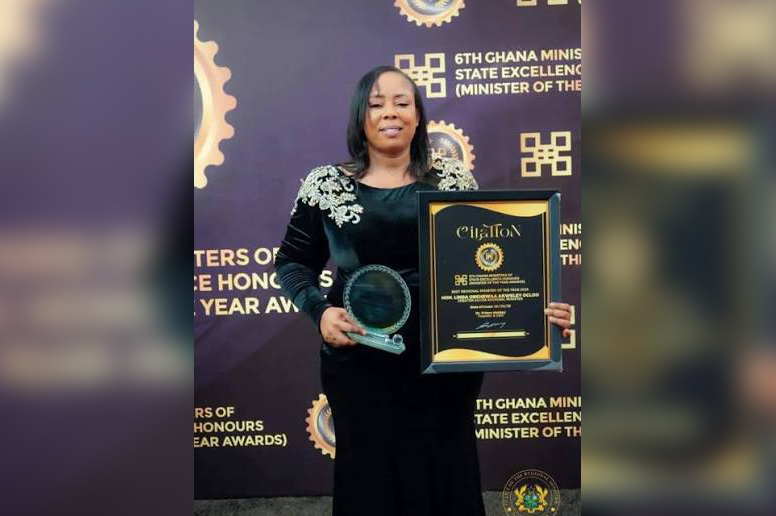
Greater Accra Regional Minister, Hon. Linda Ocloo, has been named the Best Performing Regional Minister for 2026 at the 6th Ghana Ministers of State Excellence Honours, currently underway at the Labadi Beach Hotel.#dek360ghana pic.twitter.com/EqQjuv9sHJ
— DEK360Ghana🇬🇭 (@Dek360Ghana) June 6, 2026
Speaking after receiving the controversial award, she defended her record.
“I have tackled sanitation, flooding, street lighting and boundary issues within the Greater Accra Region. If I want to break it down, we may not leave the studio.”
Award organisers share that view. According to the Chief Executive Officer of Big Events Ghana, Prince Mackay, the assessment covered January 2025 to May 2026 and considered Ocloo’s interventions, including efforts to reclaim Ramsar sites and enforce planning laws.
But outside official circles, the optics have proven difficult to ignore.
For many residents, the award arrived against the backdrop of flooded communities, recurring drainage problems and lingering complaints over public infrastructure.
At dawn, Lakeside is literally a lake now. Accra floods hit different when even the posh areas suffer. pic.twitter.com/YtaL9seE96
— 𝓚𝓘𝓓𝓓𝓞🇬🇭🇨🇦 (@heis_osei) June 4, 2026
As criticism mounted, the Regional Minister did not merely defend the award. She pushed back forcefully, suggesting politics may be driving some of the backlash.
Speaking on Asaase Radio, she referenced her long-standing political rivalry with State Interests and Governance Authority (SIGA) Director-General, Professor Michael Kpessa-Whyte.
“You know the issues between me and Kpessa-Whyte. I have defeated him four consecutive times.”
She went further, suggesting her recognition may have triggered the criticism.
“If Kpessa-Whyte believes that because I was recognised he should come after me, then that is his choice.”
The comments injected a political dimension into a controversy that had largely centred on transparency and accountability.
For Ocloo, the criticism was not just about her. It was about everyone honoured on the night.
“Are we saying that all the people who received awards, ministers, chief executives, public servants and traditional leaders, paid before they were recognised?”
The controversy raises questions that neither politics nor personalities can easily answer.
We Used To Fish Here, The Rich Ignored All Our Warnings When They Wanted To Buy The Land And Build – Sakumono Resident After Heavy Floods pic.twitter.com/b85bZTLmV3
— Zionfelix (@onua_zionfelix) June 5, 2026
If Accra continues to battle flooding after every major downpour, what benchmark was used to determine excellence?
If residents still complain about drainage, sanitation and street lighting, what evidence establishes that the region’s highest honour has been earned?
Those questions have become even more significant following President John Mahama’s directive cautioning ministers and political appointees against participating in private award schemes whose criteria are unclear or not publicly verifiable.
For now, Linda Ocloo remains Regional Minister of the Year.
But as floodwaters recede and the debate intensifies, a more uncomfortable question continues to linger over the honour: Was this a performance award, or an award that arrived before the verdict of the people?
For many residents navigating flooded streets, enduring dark roads and waiting for long-promised solutions, the answer may matter far more than the plaque itself.