The Bank of Ghana has signalled that it may reassess the country’s interest rate and monetary policy framework as renewed inflation risks from the prolonged Middle East conflict threaten to complicate Ghana’s recent macroeconomic gains.
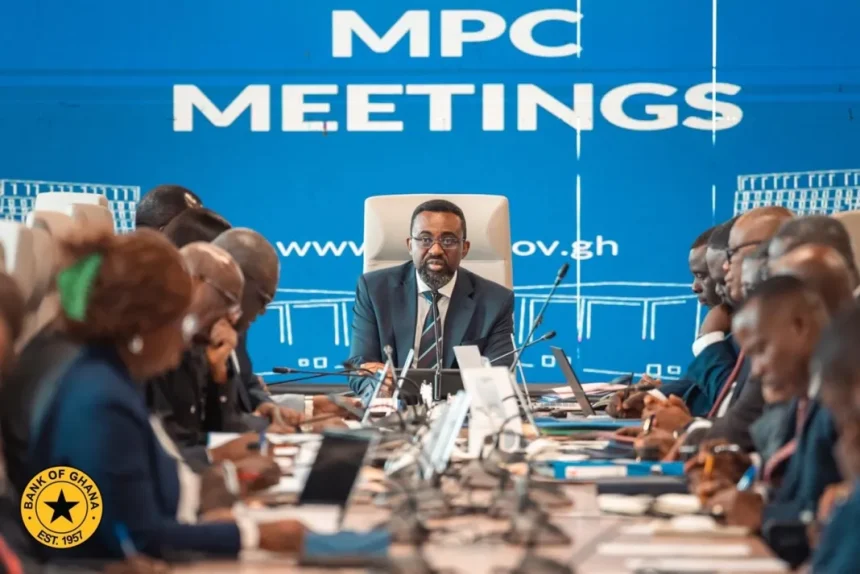
Opening the 130th Monetary Policy Committee meeting, the governor of the central bank, Dr Johnson Pandit Asiama said the domestic economy had continued to improve since the committee’s last meeting in March, supported by sustained reforms, lower inflation and improving investor sentiment.
However, he warned that rising global energy prices and worsening external conditions were introducing new risks to inflation and growth.
“The economy has improved, and they have done so meaningfully since our last meeting in March this year,” Dr. Asiama said. “At the same time, a deteriorating external environment, characterised by the ongoing conflict in the Middle East and its effects on global energy and commodity prices, is introducing new headwinds that must be weighed carefully.”
The governor said the committee would examine whether the current monetary policy stance remains appropriate as inflation risks begin to re-emerge globally. He noted that several central banks that had begun easing cycles were now pausing or reconsidering those moves due to renewed price pressures linked to higher energy costs.
For Ghana, an oil-importing economy, the external shock is expected to transmit through higher transport costs, food prices and import bills, potentially affecting inflation expectations.
Dr. Asiama said headline inflation in Ghana had increased for the first time since December 2025, while domestic energy supply disruptions and external commodity price pressures posed additional risks to price stability. “The issues range from realigning the entire interest rate structure in the economy as inflation remains low, to addressing policies to ensure inflation expectations do not become dislodged,” he said.
The governor also pointed to improving macroeconomic indicators, including a stronger external position and renewed activity in the domestic debt market. Ghana’s current account surplus in the first quarter of 2026 exceeded the same period last year by US$652 million, while the successful issuance of a seven-year domestic bond earlier this year signalled what he described as a return of investor confidence.
Government plans to raise about US$1 billion equivalent through local currency bonds to finance cocoa purchases for the 2026/27 crop season were also highlighted as part of efforts to reduce dependence on foreign currency borrowing and offshore lenders.
The remarks come as Ghana nears the completion of its International Monetary Fund Extended Credit Facility programme in August 2026; following successfully reaching a staff level agreement and prepares for a new 36-month non-financing Policy Coordination Instrument with the IMF.
According to Dr. Asiama, the proposed PCI arrangement would preserve the credibility and signaling benefits of IMF engagement while reducing reliance on IMF financing. The programme will focus on fiscal consolidation, debt sustainability, financial sector stability, monetary policy reforms and economic diversification.
He said the arrangement would also support reforms to the Bank of Ghana’s monetary operations, including improvements to liquidity forecasting, the inflation-targeting framework and policy transmission mechanisms. “The PCI represents a considered and credible next step in Ghana’s institutional engagement with the international financial architecture,” Dr. Asiama said.
Despite the improving outlook, the governor warned that risks remained elevated. He cited the prolonged Middle East conflict, higher energy prices, domestic power supply challenges and external revenue pressures as threats that could undermine inflation expectations and macroeconomic stability if not managed carefully.
The MPC is expected to conclude its deliberations and make an announcement on Wednesday, May 20, with markets closely watching for signals on the future direction of interest rates and liquidity management.