It took nearly three decades to the day for someone to be held accountable for the death of Tupac Shakur.
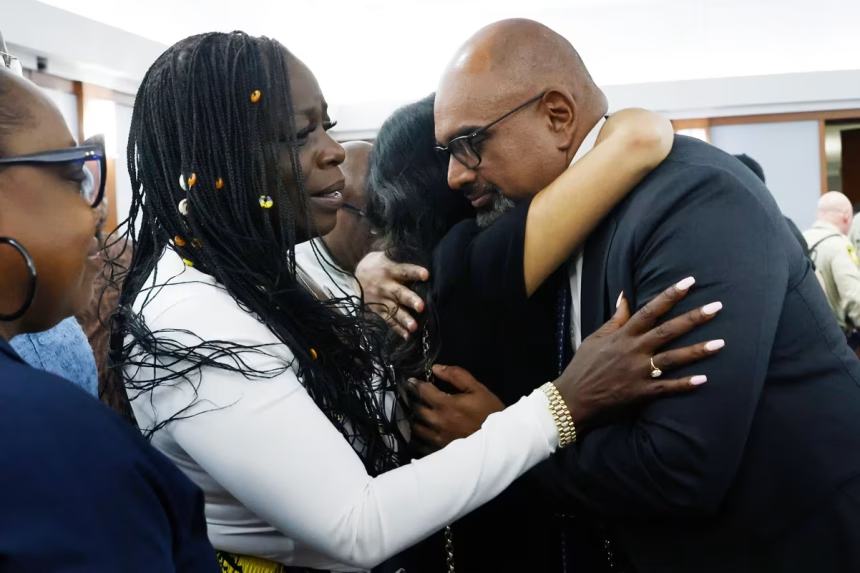
But the conviction of Duane “Keffe D” Davis was, at best, a mere illusion of justice for those who have spent the years since mourning the future the rapper was denied.
“Justice is good, but it seems hollow, you know?” said P. Frank Williams, who produced a 2017 documentary series for A&E about Shakur’s murder which touched on Davis’ alleged involvement. Sunday marks 30 years since Shakur, then 25 and at the height of his career, died after a drive- by shooting.
Prior to his death Shakur cemented himself as one of rap’s biggest stars after singles such as “I Get Around,” “Dear Mama,” “California Love” and “How Do You Want It” garnered both critical and commercial success.
He also found fame as an actor in films such as “Juice,” “Poetic Justice” and “Above the Rim.”
Death didn’t stop his stardom as he left a trove of recordings, some of which became posthumous albums. Three films he costarred in — “Bullet,” “Gridlock’d” and “Gang Related” — were also released after his death.
Shakur, it was believed, was only getting started. Thirty years later, a legal resolution has proven to be different than an emotional one.
Jeff Pearlman, author of the book “Only God Can Judge Me: The Many Lives of Tupac Shakur,” said he is still angry at how senseless Shakur’s death was — especially given who he could have become.
“He wasn’t just an artist,” the writer said. “He carried this ethos, speaking up, fighting authority, fighting the power.”

Craving justice
Shakur was shot in Las Vegas, Nevada, on September 7, 1996. Prosecutors accused Davis of riding in the white Cadillac from which gunfire erupted and hit the BMW being driven by Death Row Records co-founder Marion “Suge” Knight with Shakur in the front seat as his passenger.
Knight was only grazed by a bullet, but Shakur was hit multiple times including by a bullet that tore through one of his lungs.
Shakur died six days later.
The other alleged occupants of the Cadillac included Davis’ nephew Orlando “Baby Lane” Anderson, Deandre “Big Dre” Smith and a driver who has been identified in news reports, per the police investigation and Davis’ book, as Terrence “Bubble Up” Brown.
Anderson, whose fight with Shakur earlier in the evening is believed to have sparked the shooting, denied being involved in the killing in an interview with CNN prior to his death in 1998 in a gang-related shooting. Smith and Brown have also since died, Las Vegas Metropolitan Police have said.
“I think the situation in this case was unique. I mean, this is pretty much Duane Davis outing himself and putting the spotlight on him on what otherwise would’ve been a shelved cold case murder unsolved,” attorney Tre Lovell, who has been a litigator in high-profile cases including ones involving Justin Bieber and “Shark Tank” star Kevin O’Leary, said.
Neama Rahmani, who has appeared on CNN as a legal expert, added it’s not common for high-interest murders to go “unsolved for so many years.”
Much of the case against Davis centered on a book he co-authored, titled “Compton Street Legend: Notorious Keffe D’s Street-Level Accounts of Tupac and Biggie Murders, Death Row Origins, Suge Knight, Puffy Combs, and Crooked Cops” and interviews he had with law enforcement in 2008 and 2009 under a proffer agreement, in which a suspect gives potentially useful information to police under the condition that police cannot use it against them, with some exceptions.
Also often referred to as “Queen for a Day,” proffers often precede a more formal immunity grant.
In his book, Davis described his role in the fatal shooting, but his attorney claimed in court that he wasn’t actually involved in writing his book and lied about details to help sell copies. He was convicted of first-degree murder last month.
The desire by Shakur’s friends, family and fans to see someone held accountable for the rapper’s death has not waned over the years especially given that Shakur’s stardom grew even larger posthumously.

Chris Pizzello/Invision/AP
Pearlman believes Shakur would have racked up “multiple Academy Awards” by this point had his trajectory continued, acknowledging too that ages “25 and 55 are worlds apart.”
“But zero percent chance he’s sitting back on a stack of money watching ICE just grab brown people off streets,” the author said. “No way in hell.”
Williams, who covered the death of Shakur for the Los Angeles Times, agrees that the musician’s influence went far beyond his career.
“I really think he would have ran for office and made a change in the community. So it feels like he was robbed,” Williams said. “The killing of him robbed us of his talent. And I think for his family, the justice is just way too late.”
Though the Las Vegas trial is over, there is still pending legal action in Shakur’s murder case. Shakur’s stepbrother Maurice “Mopreme” Shakur filed a wrongful death suit earlier this year against Davis and other unnamed defendants, saying in a complaint that there remain “individuals who were involved in Tupac’s murder who, for 30 years, have not been held accountable for their crimes.”
“This action seeks to change that,” the complaint said.
But by Maurice Shakur’s own admission, true justice will always be elusive.
“The justice I would like, I will never get,” he told the BBC before Davis’ trial began
“I want my brother back,” he said.