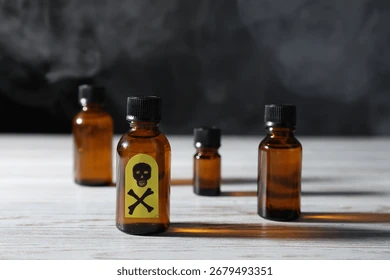
Though many parents may consider the home as the safest place for the child, globally, thousands of children are poisoned right inside their homes every year.
Most of these deaths occur in low and middle-income countries where safety practices, poison control systems, and emergency services are limited.
In Ghana, accidental poisoning remains a serious but preventable public health problem, especially among children under 5 years.
Children are naturally curious.
This curiosity places them at constant risk in homes where harmful substances are not safely stored.
These children love to explore the world by touching, tasting and smelling the objects in their environment.
A child may easily mistake kerosene stored in a water or soft drink bottle for water or drink.
Medicines may look like sweets. Brightly coloured detergents and cleaning agents can attract curious toddlers.
In Ghanaian households, kerosene poisoning is one of the commonest childhood emergencies.
This is largely because kerosene is stored in empty water or beverage bottles in many homes.
Pesticides and insecticides used in farming communities are also major causes of severe poisoning and death.
Other common poisons include bleach, caustic soda, toilet cleaning agents, and detergents.
Poisons
Medicines, alcohol, and herbal preparations found in many homes may not normally be considered poisons, but they can become dangerous when taken accidentally or in large quantities by children.
In some cases, caregivers have unknowingly administered methylated spirit stored in water bottles to infants.
This simply explains how many poisoning incidents result from simple parenting or caregiver mistakes, especially unsafe storage.
Harmful chemicals and objects such as button batteries are sometimes kept on the floor, under beds, or in unlocked cabinets where children can easily access them. Some parents leave medicines in handbags, on tables, or near bedsides.
Toddlers only have to climb onto these surfaces to access these.
Mistake
Another dangerous mistake is describing medicine as “sweet” or “candy” to encourage children to take it.
Later, in the absence of adults, the children search and swallow large amounts.
Adults should avoid taking medicines openly in front of toddlers as they love to watch and imitate.
Children should also not be encouraged to drink directly from water or beverage bottles.
They often imitate adults who do otherwise and may drink from any bottle they find at home, including containers used to store harmful substances.
Poor supervision during cooking, washing, falling asleep ahead of the children or during social gatherings may create opportunities for children to ingest harmful substances within their reach unnoticed.
All medicines and chemicals should be locked away and kept out of children’s reach and sight. Harmful substances must never be stored in soft drink or water bottles.
Products should remain in their original containers with proper labels.
Any other containers should be labelled boldly.
Parents and caregivers should safely dispose of expired medicines and empty chemical containers instead of leaving them around the house.
Indoor charcoal burning, poor ventilation, and generators placed close to windows can expose children to dangerous carbon monoxide gas. Parents must ensure proper ventilation and keep generators far from the living area.
When poisoning occurs, parents should remain calm and immediately identify the substance involved if possible.
The child should be rushed to the nearest hospital with the poison container or label. Importantly, vomiting should not be induced with palm oil, milk, raw eggs, or herbal mixtures.
This may worsen the situation rather than help. If poison enters the eyes or touches the skin, the affected area should be washed thoroughly with running water for at least fifteen minutes.
If poisonous fumes are inhaled, the child should be moved into fresh air immediately.
Difficulty breathing, seizures, excessive sleepiness, persistent vomiting, or burns around the mouth are danger signs requiring urgent medical attention.
Most childhood poisonings are preventable.
A few simple safety measures in the home can protect children from severe injury, disability or death.
Protecting children from poisoning is not only a family responsibility but also an important public health priority for Ghana.
The writer is a Child development expert/Fellow, Zero-To-Three Academy, USA. E-mail: nanaesi.gaisie@wellchildhaven.com