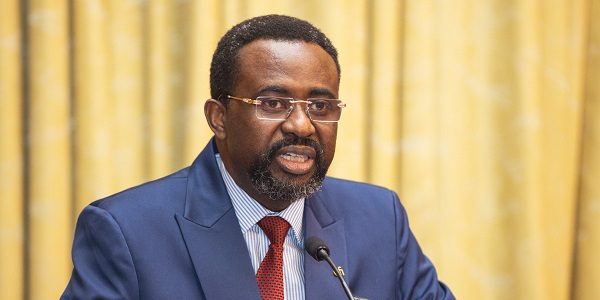
At a critical moment for African economies, Governor of the Bank of Ghana, Dr. Johnson P. Asiama, has urged the international community to move beyond incremental support and adopt more decisive reforms to help the continent sustain its hard-won economic gains.
Speaking at the African Consultative Group meeting during the 2026 IMF–World Bank Spring Meetings, Governor Asiama struck a tone that was both measured and firm, acknowledging progress, but warning that the road ahead is becoming more complex.
The meeting, chaired in the presence of IMF Managing Director Kristalina Georgieva, came just a day after the International Monetary Fund projected that Africa’s growth would slow from 4.5 percent in 2025 to 4.2 percent in 2026, citing tightening global financing conditions, rising debt burdens, and geopolitical tensions.
Against this backdrop, Governor Asiama positioned Africa not as a passive recipient of global shocks, but as a region that has already made difficult adjustments and now deserves a more responsive international system.
In his intervention, Asiama pointed to the “exceptionally challenging macroeconomic environment” facing African economies, highlighting the combined impact of high debt vulnerabilities, climate shocks, and structural constraints. These pressures, he noted, have been further intensified by spillovers from the Middle East conflict, which are feeding inflation and worsening external balances across the continent.
His remarks aligned closely with the IMF’s broader concerns. The Fund has warned that renewed inflation risks, food supply disruptions, and tighter global liquidity could easily reverse the stabilization gains achieved over the past two years.
Yet, rather than dwell on the risks alone, Asiama’s intervention shifted quickly to solutions, practical, system-level changes that could redefine how the global financial architecture supports emerging economies.
At the heart of his message was a call to fix what he described as a critical weakness in the global system: sovereign debt resolution.
He urged the IMF to use its convening power more decisively to ensure faster and more predictable debt restructurings, particularly under the G20 Common Framework. Delays, he argued, often stem not from policy failures in debtor countries, but from coordination challenges among creditors, yet countries bear the cost of these delays.
By making this distinction clear, Asiama reinforced a broader African position: reform efforts at home must be matched by efficiency and fairness in the international system.
Beyond debt, the Governor also pressed for a more agile IMF, one that can respond to overlapping crises with speed and scale.
He called for expanded concessional financing, faster deployment of climate-related funds, and more flexible use of instruments such as the Resilience and Sustainability Trust. The goal, he suggested, is not just to provide liquidity, but to help countries manage simultaneous shocks, economic, environmental, and financial, without derailing reform programmes.
This message resonated with the IMF’s own commitment to remain “an agile institution,” as reaffirmed by Georgieva, particularly in helping African economies tap into new financing avenues, including green investments.
For Ghana, Asiama’s intervention carries added significance. The country has emerged from a period of severe macroeconomic stress and is increasingly being cited as an example of stabilization through disciplined policy and international cooperation.
By speaking with clarity and authority at a high-level forum, the Governor reinforced Ghana’s growing influence in shaping continental policy discussions, moving from a position of recovery to one of leadership.
What stood out in Asiama’s remarks was the shift in emphasis. The conversation is no longer just about stabilisation. It is about resilience, how African economies can withstand future shocks without repeated cycles of crisis.
That shift aligns with the IMF’s evolving policy priorities: reducing inflation, protecting vulnerable populations, and building stronger economic buffers.
But Asiama’s intervention added an important layer, resilience cannot be built on domestic reforms alone. It requires a global system that works more efficiently, responds more quickly, and shares the burden more fairly.
As the Spring Meetings continue, the message from Africa is becoming harder to ignore. The continent has done the hard work of stabilisation. Now it is asking for a system that keeps pace.
In that conversation, Governor Asiama is emerging as one of the voices pushing for change, quietly assertive, technically grounded, and focused on outcomes.
And at a time when global uncertainty is rising again, that kind of leadership is likely to matter more than ever.