
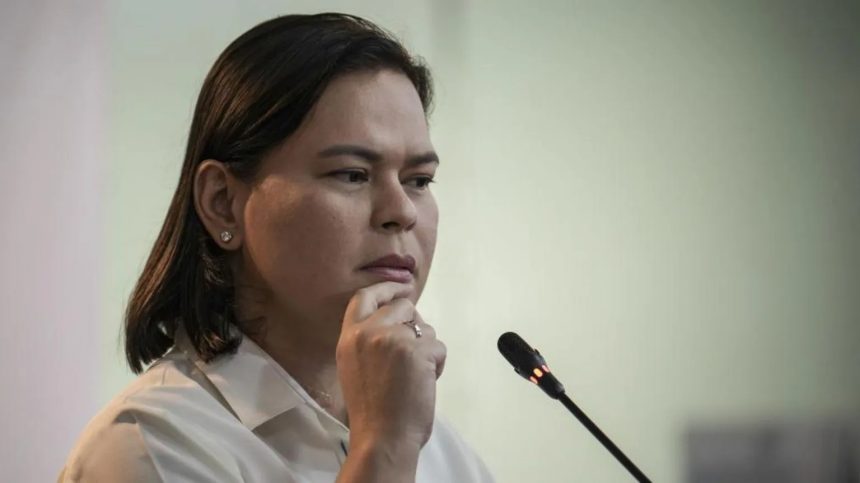
Philippine Vice President Sara Duterte’s impeachment trial has started, putting her plans to run for president in 2028 on the line.
Duterte will be removed from her post and banned from holding public office if found guilty of misusing public funds and threatening to assassinate President Ferdinand “Bongbong” Marcos Jr.
The trial opens a new theatre in the explosive feud between Marcos and Duterte, whose alliance imploded in public view soon after winning the 2022 election by a landslide.
The vote of 16 of 24 senators in the impeachment court is needed to convict the 48-year-old, who is the daughter of former President Rodrigo Duterte.
However, the outcome of the trial is hard to predict as the Senate is split between Marcos and Duterte and alliances are constantly shifting.
This year alone, the Senate has had four presidents and each leadership change, called a “coup” by the local press, has been decided by the defection of just a few senators.
This is typical of Philippine politics, which is dominated by dynasties, and where changing alliances often determine the power dynamics in government.
Complicating matters is the fact that two senators allied with Duterte have been arrested in recent weeks while another has gone into hiding from the International Criminal Court.
It is unclear if the three are able to vote in absentia.
Duterte’s corruption charge stems from the alleged misuse of millions of dollars during her term as education minister. They centre on expense claims Duterte made, which she has refused to explain, citing the need for confidentiality.
“If a small village treasurer can’t explain missing funds, he is investigated. If a school principal squanders public funds, even just 5,000 pesos ($81; £60), she is punished.
“If ordinary people are held to account, why not the most powerful government official?” said congresswoman Gerville Luistro, who delivered the opening argument for the prosecution.
The vice-president’s lawyer Sheila Sison in turn said “it is clear that the objective [of the trial] is to oust her”.
Duterte got 32 million votes in the 2022 election, more than Marcos or any of the senators and congressmen involved in the impeachment proceedings, Sison said. Duterte herself was not present at the trial.
Thousands of police officers, many of them armed in riot gear, were deployed outside the Senate building in Metro Manila amid worries of unrest, as pro-Duterte and pro-Marcos protesters gathered outside.
Dozens of reporters were packed into a separate room inside the building to cover the trial, while Filipinos across the country watched the proceedings closely via livestreams and at local watch parties.
The Senate has granted a maximum of 92 days for the trial, which is the first for a sitting vice-president in the Philippines.
The nation has seen heightened political tension in the weeks leading to the trial.
In May, an alleged shooting unfolded in the Senate after a prominent Duterte ally, Bato dela Rosa, helped to install another ally, Alan Peter Cayetano, as Senate president.
Dela Rosa, who was the chief enforcer of Rodrigo Duterte’s deadly war on drugs from 2016 to 2018, is on the run after the International Criminal Court unsealed an arrest warrant against him.
Then in June, Cayetano, who was the elder Duterte’s foreign minister, was removed as Senate president.
Just last week, authorities file a plunder case against yet another Duterte ally-senator, Rodante Marcoleta. In response, Marcoleta’s supporters from an influential religious group staged three days of protests on Manila’s main highway.
Marcoleta turned himself in on Monday, hours before the impeachment trial began.
Marcos’ office said on Monday that the president has “far more important work to attend to” than to monitor the trial, but urged Duterte to attend proceedings so that she can personally answer to the charges.
In response, Duterte said her absence “does not diminish accountability or imply a lack of transparency”, adding that Marcos’ opinion on her impeachment is of “no importance” to her.