Germany has approved almost 800 million euros ($913m) in arms export licences to Israel in the first five months of 2026, more than in the previous 20 months combined, the government in Berlin has confirmed.
According to a Federal Foreign Office reply to a parliamentary question by the far-right Alternative for Germany (AfD) party, nearly all the approvals were cleared in April and May.
The approvals portend a dramatic surge in weapons exports to Israel from one of the country’s most steadfast allies in Europe despite the German government’s insistence that it is concerned about the devastation wrought by Israel’s military in Gaza.
The government said more than 60 percent of the value of the arms licences is earmarked for a single, unnamed “major maritime project”.
The most likely candidate, analysts said, is a submarine built by the German manufacturer TKMS.
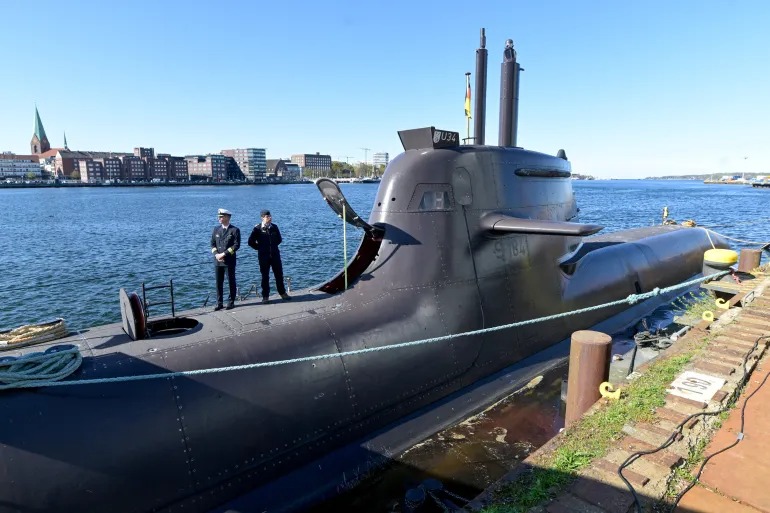
The INS Drakon, a nuclear-capable Dolphin II-class submarine, underwent its maiden voyage last year at a shipyard in Kiel on the Baltic Sea. Its estimated value is 480 million euros ($548m). It was officially handed over to the Israeli Navy last week, according to German media reports.
According to several reports, it could feature a vertical launching system (VLS), enabling it to launch nuclear-tipped cruise missiles or ballistic missiles. Israel would become only the second navy after South Korea known to field a VLS on a modern, air-independent propulsion (AIP), conventionally powered submarine.
During its sea trials, the submarine’s tower was covered with tarpaulins and fibreglass plates to prevent observers from determining its weapons configuration. Strategically, submarines of this class could provide a sea-based second-strike capability the ability of a country to fire back nuclear weapons after it has itself faced a nuclear attack.
In May, TKMS signed a memorandum of understanding on future collaboration with Elbit Systems, Israel’s largest private defence contractor.
The German Foreign Office and Ministry of Economic Affairs and Energy, under whose purview arms export licences fall, both declined to comment on the matter.
Max Mutschler, a senior researcher with the Bonn International Centre for Conflict Studies, told Al Jazeera: “Unfortunately, the fact that the federal government does not explicitly mention this is also typical of the lack of transparency surrounding arms exports.”
Last year, reports conflicted over whether the export licence for the submarine had been granted. The order dates back to 2012. While TKMS indicated approval, the German government denied it at the time.