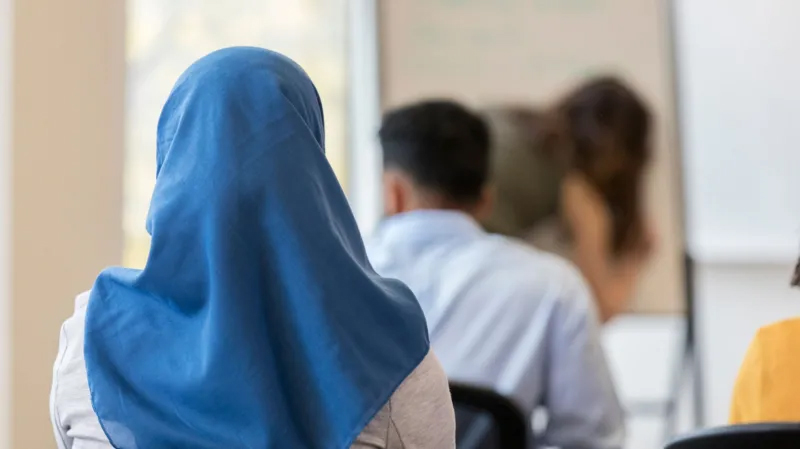
As the new school year begins in Austria, a law banning headscarves in schools for girls under 14 has gone into force.
The law forbids “traditional Muslim” head coverings, such as hijabs or burkas, in public and private schools across the country.
Integration Minister Claudia Bauer, from the conservative People’s Party (ÖVP), says the headscarf is “a sign of oppression and a means of controlling girls from the earliest childhood”.
But critics say the new law is fuelling anti-Muslim feeling in the country and could be unconstitutional.
The law was brought in by the conservative-led coalition of three centrist parties, the ÖVP, the Social Democrats (SPÖ) and the liberal Neos. They say the law is a “clear commitment to gender equality” and is intended to protect the rights of young girls.
Carla Amina Baghajati, from the official Islamic Community in Austria (IGGÖ), told the BBC that the organisation “firmly opposes the ban”.
“We believe it unjustifiably restricts the fundamental right to freedom of religion and disproportionately affects Muslim girls,” she said.
“Rather than protecting children, it singles out a specific religious practice and risks excluding the very children it claims to support.”
The IGGÖ said it would support legal challenges by girls and their families “who believe that their fundamental rights are being infringed” and who wished to bring their cases before the Constitutional Court.
The court struck down a previous ban on headscarves in primary schools in 2020 on the basis that it contravened the principle of Austria’s religious neutrality.
Teachers are expected to enforce the new ban if they see a child wearing a headscarf by holding a series of talks with the student and their legal guardians.
If there are repeated violations, child services must be notified and as a last resort, guardians could face fines of up to €800 (£685).
The Green Party’s Sigi Maurer accused Education Minister Christoph Wiederkehr, from the liberal NEOS, of “creating new conflicts and offloading them onto the teachers”.
She said teachers were “already under enormous strain” and that Wiederkehr wanted to “foist the role of police officers onto them” on top of their other duties.
The opposition far-right Freedom Party (FPÖ) says the current ban doesn’t go far enough. It is calling for a general prohibition on headscarves and face coverings in schools for students and teachers alike.
The FPÖ’s Ricarda Berger said there was “no place for political Islam in Austria, and certainly not in our schools”.
Austria’s Chancellor Christian Stocker, leader of the ÖVP, recently called for a constitutional ban on political Islam, telling Austrian public broadcaster ORF he did not “want to live in an Islamic state”.
In France there has been a ban on wearing any conspicuous religious symbols, including headscarves, turbans and kippas, in schools for more than 20 years.
The Austrian law differs from French legislation in that it specifically targets head coverings worn by Muslim women.
Austria, like several other European countries including France, Belgium and Denmark, bans the full face veil (niqabs or burkas) in public.
Baghajati said the IGGÖ was concerned about “a troubling trend” across Europe “in which complex social challenges are reduced to symbolic measures aimed at minority groups.”
“Such approaches may generate political attention, but they rarely solve the underlying problems,” she said.